
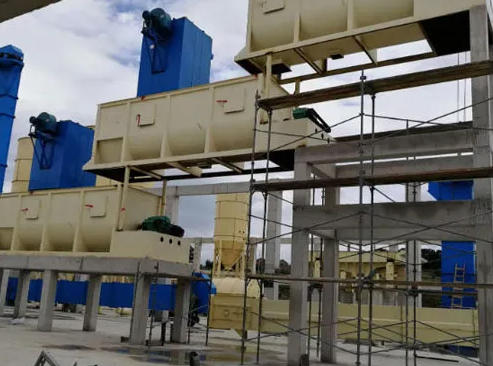
A lime hydrator converts quicklime into dry hydrated lime for storage, bagging and industrial use. For a lime producer adding a powder product to its range, the important question is how consistently the plant can meet the buyer’s moisture, fineness and chemical requirements. A machine sized only by tonnes per hour may leave the classifier overloaded or deliver powder that is difficult to handle.
AGICO Cement supplies lime hydration equipment and complete lime production solutions. Our three-stage lime hydrator can be considered as the core of a new dry hydrate line or as an addition to an existing quicklime plant. Feed preparation, water dosing, vapor extraction and downstream classification need to be selected together. For a project covering the full process, see our hydrated lime plant solution.
Get a Quote!What the Lime Hydrator Produces?
Hydrated lime is calcium hydroxide, normally supplied as a fine dry powder. It is produced by reacting quicklime with water. The simplified reaction for high-calcium lime is CaO + H2O → Ca(OH)2 + heat. The heat release is an operating consideration, not an optional part of the process.
A dry hydrator controls the reaction while limiting free water in the discharged product. Dry does not mean water-free: part of the water is chemically bound in calcium hydroxide. The remaining free moisture affects flow, storage and packaging. Specify free moisture separately from the chemical composition when requesting a quotation.
The feed must be quicklime, not uncalcined limestone. A hydrator does not replace a kiln and cannot turn calcium carbonate directly into calcium hydroxide. Feed purity also matters. Unburned material and other impurities do not disappear simply because the lime has passed through a hydration machine.


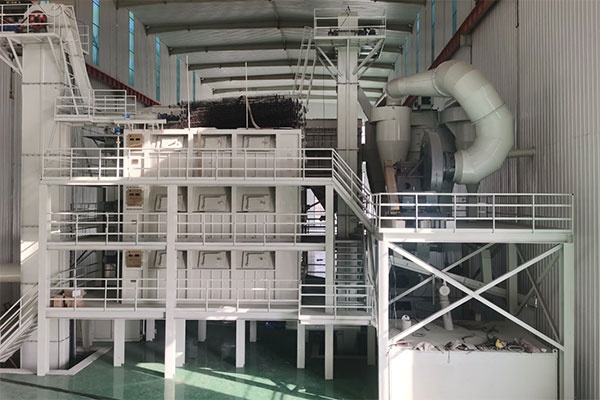
How the Hydration System Works?
Metered Quicklime and Water
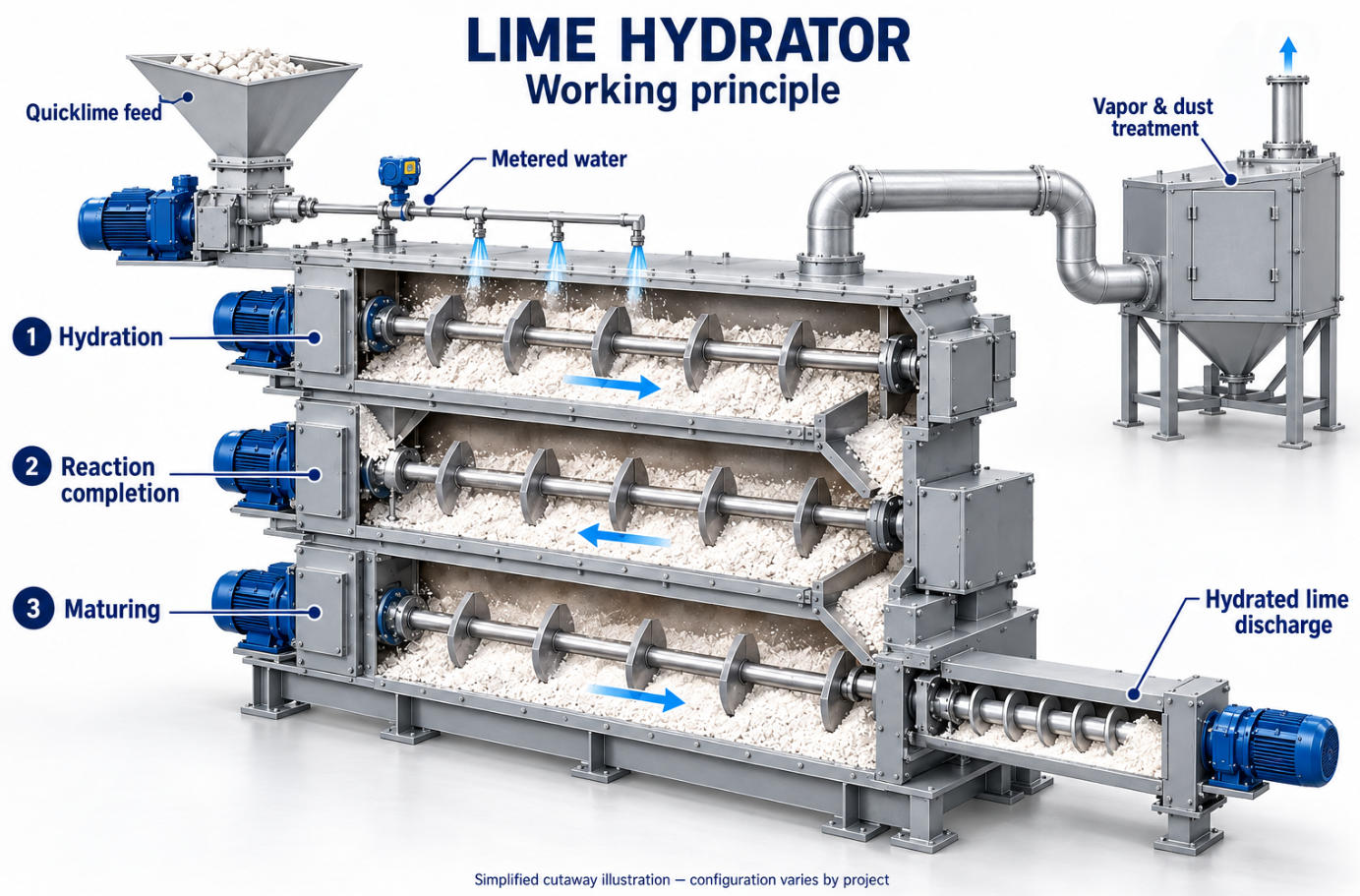
Prepared quicklime passes from a buffer hopper through a controlled feeder. Water is introduced at the selected rate as the material enters the reaction zone. Stable feeding gives the control system a useful basis for regulating water; intermittent surges make moisture and temperature harder to manage.
Ask for the feeder’s operating range, the method used to measure water flow, and the response to loss of either material or water. The quotation should also identify how steam is kept out of the upstream feed system.
Staged Mixing and Reaction
AGICO’s published arrangement combines three hydration stages. Mixing brings water and quicklime into contact and helps break up agglomerates. Subsequent stages provide further reaction time before discharge. The required operating conditions depend on the quicklime, particularly its reactivity and size distribution.
Residence time should be established with representative feed. Increasing throughput through an unchanged machine can reduce the time available for reaction; therefore, a higher feed rate should not be accepted without checking product quality.
Product Finishing and Transfer
The hydrate is then prepared for its intended market. Classification separates the required product fraction, while deagglomeration or grinding may be included when the specification calls for it. A mesh figure on a sales sheet should not be treated as a guarantee from the hydrator alone.
The final powder passes to enclosed handling, storage and dispatch. A properly selected lime storage silo should be matched to the hydrate’s actual flow behavior and storage duty. Confirm the venting, withdrawal arrangement and usable storage capacity before finalizing the plant layout.
Features of AGICO Cement Lime Hydrator
Water Addition Matched to the Feed
The useful benefit of controlled dosing is repeatability. A steady product is easier to classify and sell than a line that alternates between damp powder and incompletely reacted material. Include the water quality and seasonal inlet temperature in the design information rather than treating water as an unlimited, constant utility.
Mixing Suited to Variable Quicklime
The mixing arrangement should be selected around the material being processed. Ask how the equipment accommodates agglomerates and how operating load is monitored. During commissioning, retain samples from different feed conditions so that adjustments can be linked to measured product changes.
Planned Vapor and Dust Handling
Hydration produces a hot, moisture-bearing exhaust. Its collection system needs to be designed for that duty, including condensation management and maintenance access. An ordinary dry transfer-point filter should not be assumed suitable without checking the operating conditions.
Access for Routine Maintenance
Inspection covers, drive access and space for removing wear parts are useful only if they remain accessible after installation. Review the arrangement with the maintenance team before approving the support structure. Include lifting access, isolation provisions and a practical inspection schedule in the equipment package.
A Defined Downstream Interface
The hydrator, classifier and storage system must agree on capacity and product condition. Specify the boundary at each transfer point, including temperature, moisture, material loading and the equipment responsible for conveying it. This helps prevent gaps between separate supply packages.
Reference Technical Specifications
The following values provide a starting point for discussion, not a guaranteed performance schedule. The catalogue presents a capacity range rather than a model-by-model series; model codes and dimensions must be confirmed in the project quotation.
| Parameter | Published reference | Selection note |
|---|---|---|
| Capacity | 2–30 t/h | Confirm whether the quoted duty is quicklime feed or finished hydrate. |
| Hydration rate | At least 96% | Agree the test method and feed specification. |
| Product fineness | 100–600 mesh | Associated classification duty; define particle-size acceptance. |
| Residual moisture | At most 1% | Catalogue table value; confirm the contractual free-moisture limit. |
| Quicklime consumption | 0.75 t/t hydrate | Reference only; actual yield depends on feed and rejects. |
| Water consumption | 0.5 m³/t hydrate | Clarify total plant water and any recycled water. |
| Specific power consumption | 4 kWh/t hydrate | Confirm the included equipment; not total installed motor power. |
| Power supply | 380 V ±10%, 50 Hz | Adapt the electrical design to the project supply. |
Lime Hydrator Compared With Lime Slaker
Both names describe equipment that reacts quicklime with water, and suppliers sometimes use the terms interchangeably. The practical distinction is the required discharge product. Lime hydrator means the dry-powder production system, while wet lime slaker means a system intended to deliver milk of lime or lime slurry.
| Selection point | Dry lime hydrator | Wet lime slaker |
|---|---|---|
| Main output | Dry hydrated lime powder | Calcium hydroxide slurry |
| Typical purpose | Produce hydrate for storage, sale or dry dosing | Prepare reagent for a wet process |
| Water management | Control reaction and discharged free moisture | Control reaction and required slurry concentration |
| Downstream equipment | Classification, powder storage and packing | Grit handling, slurry tanks and pumps |
| Useful acceptance checks | Hydration, moisture, fineness and saleable output | Slurry concentration, grit and delivery duty |
| Best starting question | What powder specification must the customer receive? | What slurry must the process consume? |
If the end user needs a continuous slurry supply for water treatment or another wet process, compare the complete lime slaker system before choosing a dry hydrate line. Producing powder and then mixing it back into water adds handling stages, although powder production can make sense when the same plant supplies several markets.
Conversely, a slurry slaker does not automatically provide a saleable dry powder product. Drying, classification and powder handling cannot be assumed to be included. State the required product form at the beginning of the inquiry, even if the supplier’s catalogue uses both names.
Applications for Dry Hydrated Lime
Commercial Hydrated Lime Production
Quicklime producers can add hydration when customers require bagged or bulk powder rather than lump quicklime. The business case should include saleable yield, product testing, storage, packaging and local demand. A high nominal production rate is of limited value if the product misses the buyer’s specification.
Construction Materials
Hydrated lime is used in construction products, including suitable mortar and plaster formulations. Buyers may care about fineness, consistency and chemical composition as well as output. Confirm the intended product grade; a general industrial hydrate should not be offered as a certified construction grade without the required testing.
Dry Sorbent Preparation
Dry flue-gas treatment can require hydrate with properties beyond a mesh specification. Where the application requires a particular specific surface area or sorbent performance, include those requirements in the test program. A conventional hydrate line should not be presented as a high-surface-area process without supporting results.
Industrial Reagent Supply
Dry hydrate can be supplied to users that prepare their own slurry or use powder directly. Agree packaging and delivery requirements alongside chemistry. For applications with strict impurity limits, assess the quicklime source first; changing the machine configuration alone may not solve the problem.
How to Select a Lime Hydrator?
Quicklime Analysis
Start with a representative quicklime sample and an analysis covering available lime, magnesium content, impurities, moisture and particle size. Include reactivity information where available. A sample selected only from the best kiln production may not represent the feed the hydrator will receive during normal operation.
Product Requirements
Then define the product. Provide required output in tonnes per hour, free moisture, fineness or particle-size distribution, and any chemical or application-specific limits. Distinguish laboratory targets from the minimum acceptable commercial specification.
Site and Utilities
Next, review the site. Send the available footprint and elevation, existing feed and discharge points, electrical supply, water availability and intended dust-exhaust arrangement. For a retrofit, identify equipment that must remain in service and the available shutdown window.
Supply Scope
Compare proposals on the same supply boundary. One offer may cover the hydrator only; another may include feeders, controls, classification and collection equipment. Request a clear list of exclusions, civil loads, utility consumption assumptions, commissioning responsibilities and recommended initial spares.
Capacity Bottlenecks
For a capacity increase, examine the bottleneck before ordering a larger machine. The limiting item may be the feed system, exhaust handling, classifier or dispatch arrangement. Replacing the hydrator without checking these interfaces can leave the practical plant output unchanged.
Why Choose Us?
International Certification
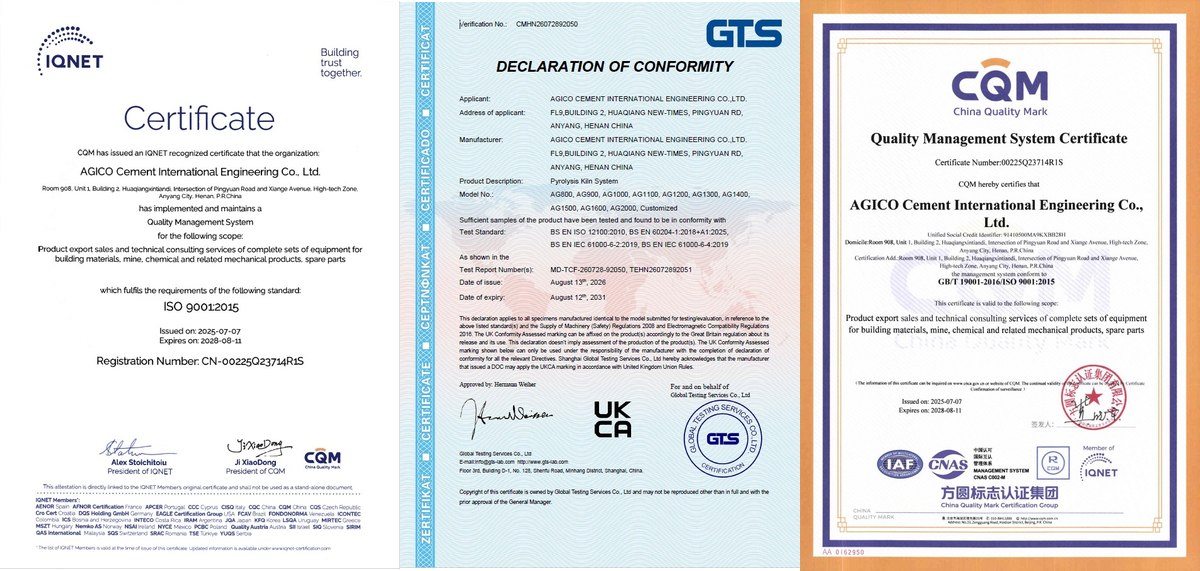
AGICO CEMENT’s quality management system is certified to ISO 9001:2015. The documents shown here cover company quality management and product conformity within their stated scopes.
Easy Maintenance
Accessible drives, inspection points and wear parts help simplify routine maintenance.
Environmentally Friendly
Dust collection and vapor handling are planned around the hydration process and site conditions.
Customized Service
Equipment selection is matched to your quicklime feed, hydrate specification and available plant space.
Lime Hydration Solutions
Coordinate the hydrator with feeding, classification, storage and packing for a complete production line.
About 20 Years of Experience
AGICO brings lime equipment experience to project planning, equipment supply and technical support.
Send AGICO your quicklime analysis, required hydrate output, product specification and site layout. State whether the inquiry is for the hydrator alone or for a complete line with classification, storage and packing. Our engineering inquiry team can use that information to discuss the equipment scope and the next steps for selection.
If you are still choosing between powder production and an on-site slurry system, include the final application and annual demand. That decision should come before the equipment size.
Get a Quote!Frequently Asked Questions
The terms overlap. Both involve reacting quicklime with water. Check whether the proposed machine discharges dry hydrate, paste or slurry, and compare the complete process rather than relying on its name.
No. Limestone must first be calcined to produce quicklime. Hydration is a subsequent process that converts reactive oxide to hydroxide.
No. The appropriate fineness depends on the application. Chemical composition, residual unreacted material, moisture and sometimes specific surface area also matter. Specify the properties that the customer actually needs.
It requires separate assessment. Calcium and magnesium oxides do not necessarily hydrate to the same extent under ordinary atmospheric conditions. Do not apply a high-calcium quicklime performance basis to dolomitic feed without testing.
Not by itself. The quotation should define the capacity basis, feed quality, product specification and auxiliary equipment included. Finished saleable output is the useful figure for a commercial production line.
Provide feed analysis and size, required product output and quality, operating hours, water and power conditions, site drawings and the intended supply scope. Representative material testing may be needed before final selection.