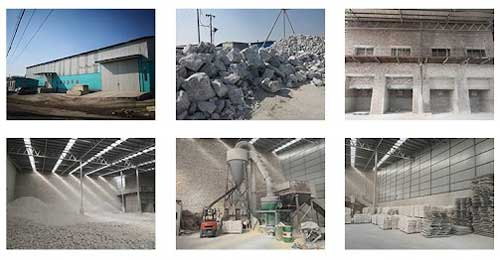
Calcined Magnesite Introduction
The main component of magnesite is magnesium carbonate (MgCO₃). When calcined, it decomposes into magnesium oxide (MgO) and carbon dioxide (CO₂). The term calcined magnesite generally refers to two main types: caustic calcined magnesite (CCM) and dead burned magnesite (DBM).
Caustic calcined magnesite, also known as light-burned magnesia, is produced by calcining magnesite at temperatures ranging from 750°C to 1100°C. This process retains some porosity and reactivity while removing CO₂, resulting in active magnesium oxide (MgO). This product, also called “light-burned magnesia” or “light-burned powder,” is highly reactive and readily reacts with water or acid.
On the other hand, dead burned magnesite (DBM) is produced by calcining magnesite at much higher temperatures, typically 1200°C to 1800°C. This process fully decomposes the minerals, forming high-density, low-reactivity MgO with a high refractory performance (melting point >2800°C). Usually, this process needs rotary kiln.
The temperature and duration of the calcination process significantly influence the reactivity of the final product, which is crucial for its industrial applications.
A calcined magnesite kiln is specialized equipment used to thermally treat magnesite (primarily MgCO₃). The primary purpose is to heat and decompose natural magnesite to produce light-burned magnesium oxide (MgO)—a process known as calcination.
Agico Cement is a professional manufacturer of calcined magnesite kilns. We provide different kinds of kilns for calcined magnesite. We offer services of custom design, quality control, low cost, strong manufacturing ability and so on. If you have any needs, please feel free to consult us!
What is Caustic Calcined Magnesia (CCM)?
Caustic Calcined Magnesia (CCM) is a compound obtained by calcining magnesite (MgCO₃) at a temperature of around 700–1000°C to remove impurities and carbon dioxide. The calcination temperature is lower than that used for dead burned magnesia (DBM), allowing some chemical activity to be retained.
CCM has a high melting point, is insoluble in water, and possesses stable chemical properties. It is valued for both its environmental remediation functions and moderate refractory properties. Its main applications include:
- Agriculture (e.g., soil improvement, feed additives).
- Environmental protection (e.g., wastewater treatment, flue gas desulfurization).
- Pharmaceuticals, rubber, and as a raw material in the chemical industry.
What is Dead Burned Magnesia (DBM)?
Dead Burned Magnesia (DBM) is a magnesium carbonate product treated at high temperatures. It is produced by heating magnesite in a rotary kiln to extremely high temperatures (usually between 1800–2000°C), resulting in complete decomposition of the mineral and the formation of a dense crystalline structure.
DBM is known for its high purity and excellent refractory properties. With its compact crystal structure and outstanding resistance to high temperatures and corrosion, DBM is widely used in industries such as: construction materials, ceramics, refractory materials etc.
Technical Parameter Comparison
| Calcined Magnesite | Temperature Range | Residence Time | Product Density | Reactivity (Iodine Adsorption Value) |
| Dead Burned Calcination Kiln (DBM) | 1200-1800°C | 2–4 hours (rotary kiln) | 3.4-3.6 g/cm³ | <20 mg/g |
| Caustic Calcined Magnesite Kiln (CCM) | 700-900°C | 30–90 minutes (shaft kiln) | 2.8-3.2 g/cm³ | >80 mg/g |

Types of Kilns used for calcined magnesite
AGICO Cement is a professional company that specializes in the design, manufacturing, and supply of equipment and complete solutions for types of kilns used for calcined magnesite. There are different types of kilns, customers should choose the suitable one according to the real situation. Choosing AGICO Cement as the manufacturer of your calcined magnesite kiln ensures you receive a high-performance, efficient, and reliable system tailored to your specific needs, at the same time, you can enjoy professional support and advanced technology.
Shaft Kiln (Vertical Kiln)
Types: Mechanized shaft kiln, traditional earth kiln.
Features: Simple structure, relatively lower energy consumption, moderate temperature control, low investment cost, suitable for small to medium-scale production. Lower thermal efficiency (fuel utilization around 40%–50%) and uneven temperature distribution. Suitable for small to medium-sized enterprises.
Fuel: Coal, coke, gas, etc.
Application: Lightly calcined magnesite to produce caustic calcined magnesia (active magnesium oxide).
Rotary Kiln
Structure: Long cylindrical inclined rotating kiln body with high-temperature-resistant lining.
Features: High level of automation, capable of continuous production with large capacity (daily output per kiln can reach thousands of tons). Precise temperature control (±10°C) ensures stable product quality. Suitable for medium to large-scale enterprises and large-scale calcination. Relatively high energy consumption (fuel consumption about 800–1200 kcal/kg of product).
Application: Calcining magnesite to produce high-purity magnesium oxide or dead burned magnesia.
Fuel: Pulverized coal, natural gas, oil.
Inclination Angle: Typically 2.5%–4%.
Calcined Magnesite Detailed Process Flow


Raw Material Preparation (Crushing and Screening)
Raw Ore Processing: Magnesite ore is usually in block form and must be crushed to a suitable particle size.
Crushing Equipment: Commonly used equipment includes jaw crushers, hammer crushers, etc.
Particle Size Control: The particle size is typically controlled within 10–40 mm to ensure uniform heating and complete calcination.
Screening: Fines and oversized particles are removed to ensure the raw material has a proper particle size distribution, improving product quality consistency.
Raw Material Preheating (Optional)
Purpose: Utilize high-temperature exhaust gas from the kiln tail to preheat materials, improving thermal efficiency and reducing fuel consumption.
Equipment: Some production lines are equipped with preheaters or vertical heat exchangers.
Effect: Preheated ore can reach temperatures of 200°C–400°C before entering the kiln, significantly saving energy.
Calcination (Core Process Step)
Core Reaction: MgCO₃ —————————————→ MgO + CO₂ ↑
Temperature Control: Ordinary active magnesium oxide: 750°C–900°C. High-activity magnesium oxide (used in pharmaceuticals, fine chemicals): 900°C–1100°C.
Calcination Methods:
- Shaft Kiln: Ore descends by gravity while hot gases rise in counterflow. Simple structure.
- Rotary Kiln: Material advances with the slow rotation of the kiln body, offering high temperature control precision and uniform calcination.
Calcination Time: Generally 20–45 minutes, depending on the equipment type and material properties.
Reaction Characteristics: Large amount of CO₂ gas is generated; a good exhaust system is essential. The reaction is endothermic, requiring a continuous and stable heat source (coal powder, natural gas, coke, etc.).
Cooling (Temperature Reduction)
Purpose: Rapidly cool the high-temperature calcined powder to prevent further sintering that could affect activity.
Cooling Methods: Air Cooling: Blower coolers directly use airflow to cool the material. Water Cooling: Rarely used due to the risk of moisture absorption. Natural Cooling: Material is slowly cooled in a material tower.
Temperature Control: Usually cooled to below 60–100°C to facilitate subsequent screening and packaging.
Finished Product Screening and Packaging
Screening: The cooled lightly calcined powder is classified by particle size—fine powder, medium powder, large particles.
Testing: Analyze indicators such as activity, MgO content, loss on ignition (LOI), and particle size.
Packaging Methods: Bulk tank transportation. Woven bag packaging (common sizes: 25kg, 50kg, 1000kg jumbo bags).
Storage Considerations: MgO is highly hygroscopic and easily reacts with CO₂ in the air to form Mg(OH)₂ or MgCO₃. Storage Environment: Should be dry and well-ventilated.
Waste Gas Treatment (Environmental Requirements)
CO₂ Emissions: A large amount of carbon dioxide is released during the calcination process.
Dust Removal: Most factories install baghouse filters or cyclone dust collectors to prevent dust pollution.
Exhaust Gas Recovery: Some advanced systems can utilize waste gas heat for preheating or power generation, improving energy efficiency.