
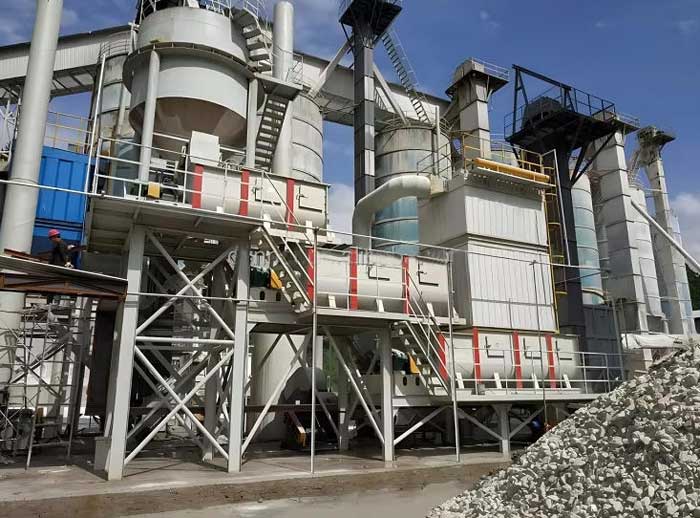
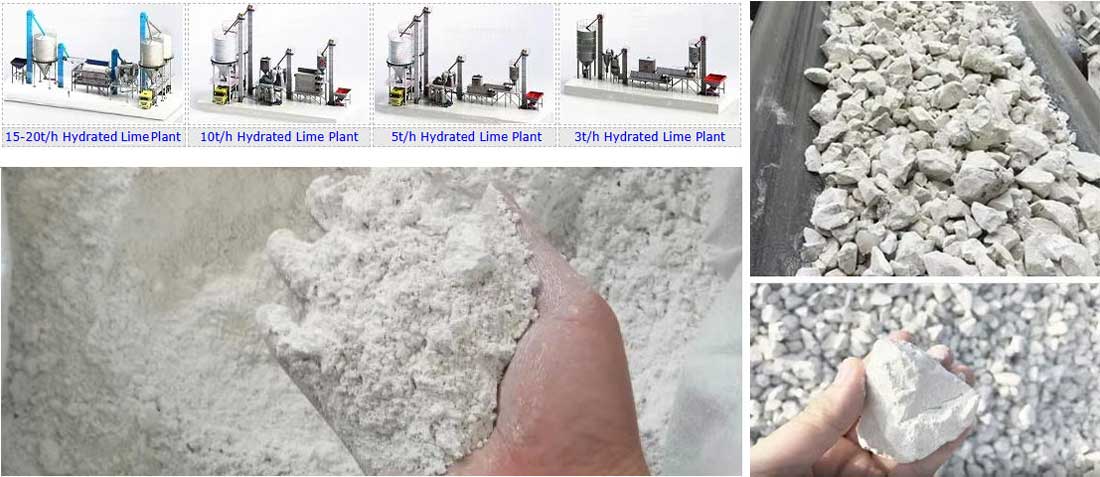
Capacity: 5 TPD, 10 TPD, 20 TPD, 30 TPD, 50 TPD, 100 TPD
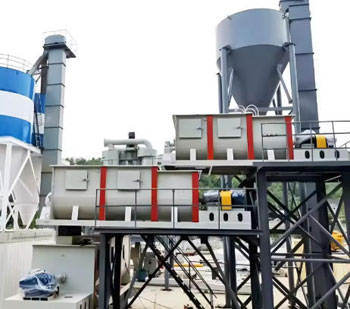
Equipment: Lime slaker, conveyor, bucket elevator, dust collector, hydrated lime silo, and packing machine, etc.
Raw material: Quick Lime (CaO)
Final product: Hydrated Lime (Ca(OH)₂)
AGICO Cement Hydrated Lime Plant, Your Reliable Choice!
What is a Hydrated Lime Production Line?
The final product of the lime production line is quick lime. But that is not enough; converting quick lime (CaO) into hydrated lime is the main function of the hydrated lime production line. In the hydrated lime plant, a complete system is designed to produce hydrated lime through the controlled slaking process.
This hydrated lime production process plays a critical role in industries such as environmental protection, water treatment, chemical processing, and construction.
The core reaction is: Quick Lime + Water → Hydrated Lime + Heat.
By calcining limestone in a lime calcination plant, quick lime can be obtained, then, via hydration, hydrated lime can be obtained. So the purity of limestone and the quality of quick lime directly affect the performance of the hydration process and the reactivity, strength, and quality of the hydrated lime produced.

Why Choose AGICO Cement
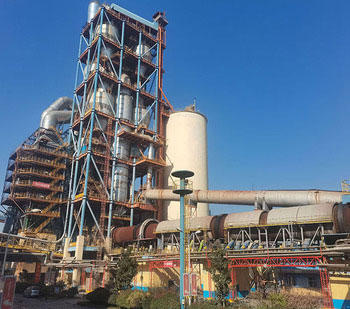
- Rich Experience: AGICO Cement has more than 20 years of experience in lime plant engineering.
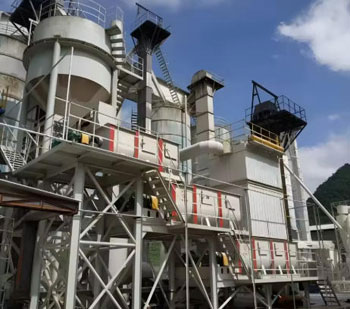
- EPC Projects: AGICO Cement offers customized and complete turnkey solutions and EPC projects for lime calcination.
- Professional Team: We have a professional design and installation team to make sure the high slaking efficiency of hydrated lime.
- High-quality Slaked Lime: The slaked lime produced by our hydrated lime plant has high reactivity and low moisture content.
- After-sales Service: We have reliable after-sales service.
- Environmentally Friendly Design: Our hydrated lime production line has a fully automatic control system and an environmentally friendly design.
- Customization: We can customize various capacities of hydrated lime plants from 10 TPD to 500 TPD.
- Reasonable Price: High-quality slaked lime and low energy consumption ensure a competitive price and high performance.
If you are looking for a reliable hydrated lime production line supplier, feel free to contact us. We will provide you with a professional solution tailored to your needs.
Hydrated Lime Production Process
Quick Lime Feeding
Quick lime is transported into the hydrated lime plant through conveyors or bucket elevators.
Lime Slaking
This is the core step in the whole hydrated lime production line. With the help of a lime slaker, the quick lime reacts with water. The lime slaking process releases heat and converts CaO into Ca(OH)₂.
Classification
The hydrated lime slurry or powder is aged and classified to ensure uniform quality.
Grinding
This is an optional step. If you want to make the slaked lime with higher fineness, this system can be added.
Dust Collection
More and more countries are paying attention to environmental protection. This process can reduce material loss and comply with the environmental protection requirements. In this process, a dust collector is necessary.
Packaging
The final hydrated lime is packed using automatic packing machines.

Limestone to Hydrated Lime Process Flow
| Stage | Input Material | Process Description | Output |
| Mining & Crushing | Limestone (CaCO₃) | Quarrying, crushing, and screening | Crushed Limestone |
| Calcination | Crushed Limestone | Heating at 900–1100°C in lime kiln | Quicklime (CaO) |
| Cooling | Hot Quicklime | Controlled cooling in cooler | Cooled Quicklime |
| Hydration | Quicklime + Water | Controlled slaking reaction (exothermic) | Hydrated Lime (Ca(OH)₂) |
| Dust Collection | Process Gas | Dust filtration (bag filter) | Clean Air |
| Storage & Packing | Hydrated Lime | Sealed storage and automatic packing | Finished Product |
Main Equipment for Hydrated Lime Production Plant

Lime Slaker (Hydrator)
This is the core equipment of the hydrated lime plant, used to react quick lime (CaO) with water to produce hydrated lime (Ca(OH)₂). This process is an exothermic reaction, and precise control of the water addition is required to ensure product quality and reaction efficiency.
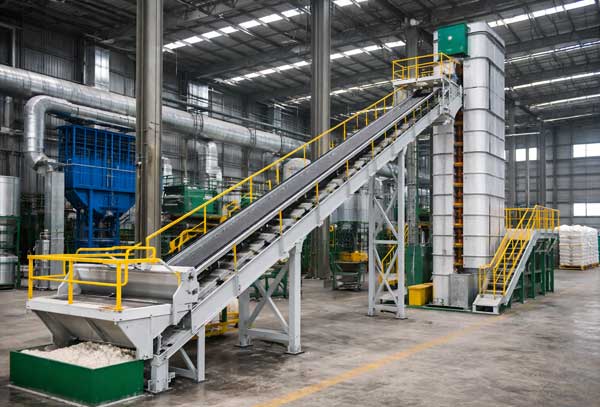
Conveyor
The transportation system is used to transfer materials between various process stages. There are three common conveyors for you to choose from. Each conveyor can ensure the continuous and stable operation of the hydrated lime production process.

Dust Collector
This is a key environmental protection equipment. It is used to collect dust generated during the hydrated lime production process, reducing environmental pollution and material loss. The most commonly used type is the bag filter, which features efficient filtration and stable operation.
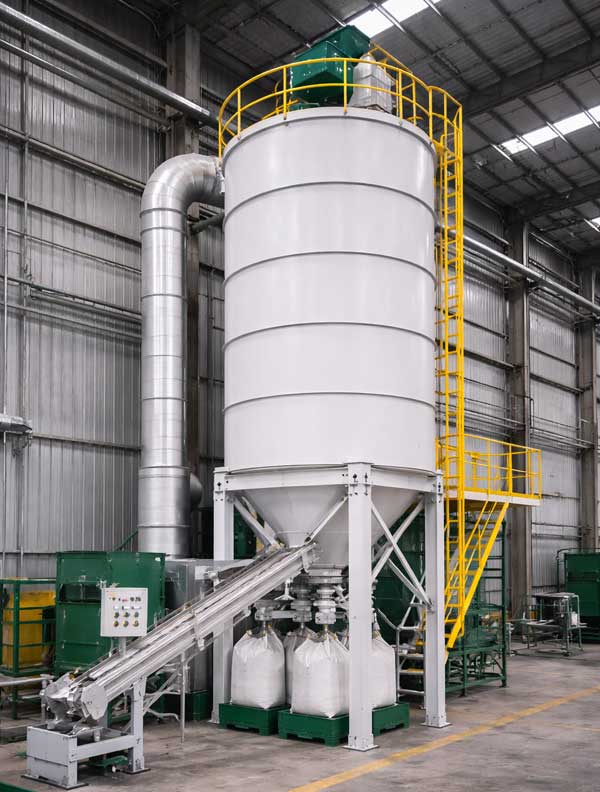
Hydrated Lime Silo
It is used to store the finished calcium hydroxide powder to prevent moisture absorption. It is usually equipped with a level gauge and a discharge device to ensure the uniform supply of the material.

Packaging Equipment
Used to automatically package hydrated lime in specific weights. It can be configured with either semi-automatic or fully automatic packaging systems according to requirements, enhancing efficiency and reducing labor costs.
Hydrated Lime Applications
Water Treatment
Hydrated lime is widely applied to adjust PH in water and wastewater treatment processes. Due to its ability to remove impurities such as heavy metals and phosphates, hydrated lime is a reliable agent for environmental protection.
Construction Industry
It is used in mortar, plaster, and soil stabilization to improve workability, durability, and strength.
Flue Gas Treatment
Hydrated lime helps remove acidic gases like sulfur dioxide (SO₂) and hydrogen chloride (HCl) from industrial emissions.
Agriculture
Applied to acidic soils to raise pH levels, improving soil conditions and increasing crop productivity.
Chemical Manufacturing
Serves as a key raw material in producing various calcium compounds and other chemicals.
Paper and Pulp Industry
Used in the causticizing process to regenerate caustic soda (NaOH) in kraft pulping.
FAQ about Hydrated Lime Plant
Q1: What is the difference between quick lime and hydrated lime?
Quick lime (CaO) is produced by calcining limestone, while hydrated lime (Ca(OH)₂) is produced by adding water to quick lime.
Q2: Is lime manufacturing environmentally safe?
With modern pollution control systems and efficient lime kilns, lime manufacturing can be conducted responsibly and sustainably.
Q3: What is the capacity of your hydrated lime plant?
We can provide solutions from 10 TPD to 500 TPD according to your requirements.
Q4: Is dust control important in hydrated lime production?
Yes, dust control is critical. Bag filters or dust collectors are used to reduce pollution and ensure a safe working environment.
Q5: Can the production line be customized?
Yes, hydrated lime plants can be customized based on raw material quality, capacity requirements, automation level, and plant layout.
Typical Chemical Technical Specifications of Hydrated Lime
| Parameter | Typical Value |
| Process Energy Consumption (kg standard coal/t lime) | 130 |
| Ca(OH)₂ Content | 90–95% |
| Moisture Content | ≤ 2% |
| Particle Size | 90% passing 325 mesh |
| Reactivity | High (fast slaking rate) |
| Bulk Density | 450–550 kg/m³ |
| Available Ca(OH)₂ | 85–92% |