

Product: Universal Jaw Crusher
Feeding Size: 125-1200 mm
Production Capacity: 1-1200 t/h
Application: A jaw crusher is a mechanical device used for crushing limestone, metal ore, coal, pebble, concrete, dolomite, bluestone, gravel, etc. widely used in building materials, metallurgy, chemical industry, cement, mining, and other industries.
Jaw Crusher Manufacturer
Crushing equipment is essential for processing rock, sand, gravel, or minerals, and there are many types and styles of crushing equipment. The lime calcination plant has the same importance as owning a limestone crusher. The specific type of limestone crusher required – jaw crusher, cone crusher, impact crusher, or other, depends on the production site, product type, and required output.
AGICO Cement is a professional jaw crusher manufacturer. We have more than 20 years of experience and can provide customers with customized limestone crusher services, whether it is primary crushing or secondary crushing.
AGICO Cement has an independent production workshop and a professional design team, which can realize the large-scale production of limestone crushers and reduce production costs. In the past twenty years, AGICO Cement has continuously invested in research and development, using advanced technology and processes to manufacture limestone crushers, and exported high-quality limestone crushers and other lime production equipment to dozens of countries and regions, gaining wide recognition and praise from domestic and foreign customers.
Jaw crushers are usually used in the initial stage of the crushing process. They break some larger and harder materials into smaller and easier to handle pieces, which can then be further reduced to size by other crushing equipment. Sometimes a cone crusher is used instead.
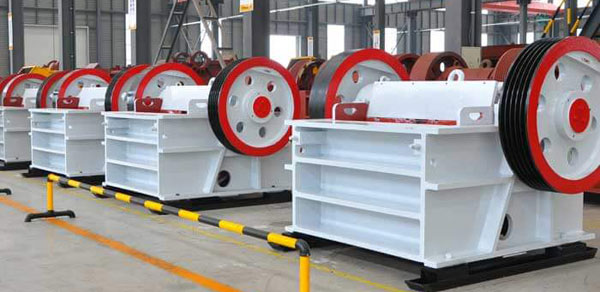
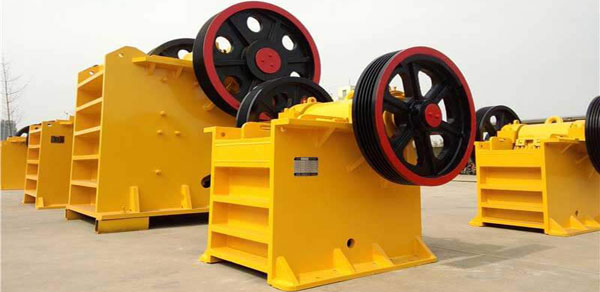
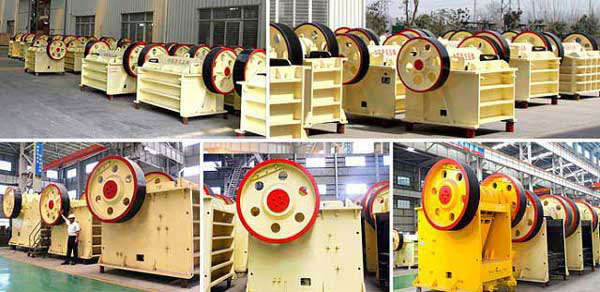
AGICO Cement Jaw Crusher Advantages
AGICO Cement jaw crushers can handle various materials, including ore, rock, construction waste, etc., and it has good adaptability to materials of different hardness and humidity. Whether it is hard granite, basalt, or softer limestone, shale, etc., a stable crushing effect can be achieved. Through precise design and adjustment of the device, the particle size of the crushed product is guaranteed to be uniform, the phenomenon of over-crushing and under-crushing is reduced, and the quality and added value of the product are improved.
Since jaw crushers are mostly used for primary crushing and are equipped with a complete dust removal system, they can effectively collect and process the dust generated during the crushing process, so fewer fine materials and dust are generated. Reduced dust pollution to the environment, in line with environmental protection requirements.
AGICO Cement has a large crushing ratio. It can crush larger-sized materials into smaller particles, the crushing ratio can usually reach about 3-8, effectively improving the crushing efficiency of the material and reducing the workload of subsequent processing. For ores with higher hardness, efficient crushing can also be achieved.
The whole jaw crusher has a compact structure and a small footprint, which is convenient for installation and layout in different work sites. Whether it is a large cement production line or a small quarry, it can adapt well to the site space requirements and improve the flexibility of equipment use.
The various components of the jaw crusher adopt a modular design, which is easy to disassemble and replace, greatly shortening the maintenance time and cost. For example, the replacement process of wearing parts such as jaw plates and toggle plates is simple and quick, which reduces the downtime and maintenance time of the equipment and improves the utilization rate of the crusher.
Advanced energy-saving technologies such as optimized transmission systems and crushing chamber structures are adopted to reduce the energy consumption of the jaw crusher. Compared with traditional jaw crushers, AGICO cement’s jaw crusher can save about 15%-30% of energy, effectively reducing production costs.
The frame is made of high-quality steel and advanced welding technology, which can withstand large crushing pressure and vibration, ensuring the stability and reliability of the jaw crusher in long-term operation. For example, in harsh working environments such as large mines, it can still maintain a stable working state and reduce downtime caused by equipment failure.
The optimized crushing chamber design and reasonable motion parameters have improved the feeding capacity and discharging speed of jaw crusher. The single machine has a strong production capacity and can meet the needs of large-scale production. Taking a large jaw crusher as an example, the processing capacity per hour can reach hundreds or even thousands of tons.
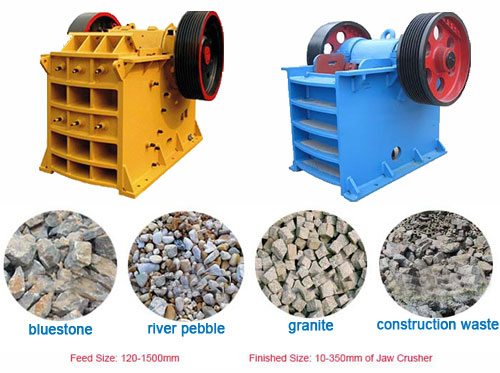
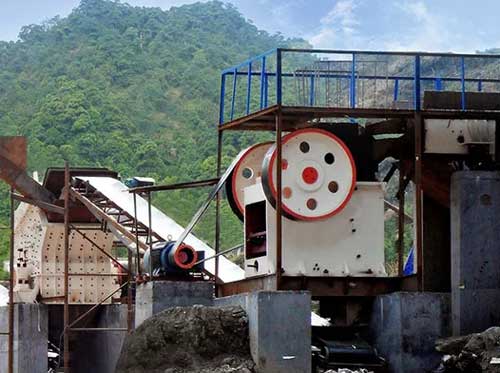
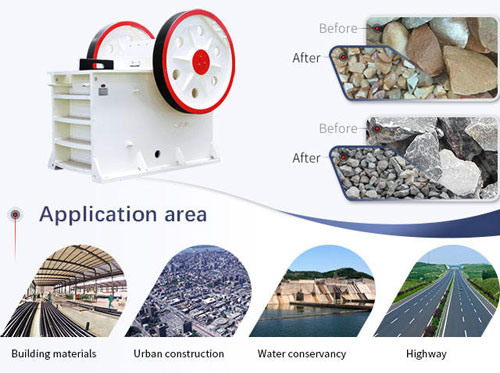
Universal Jaw Crusher Working Principle
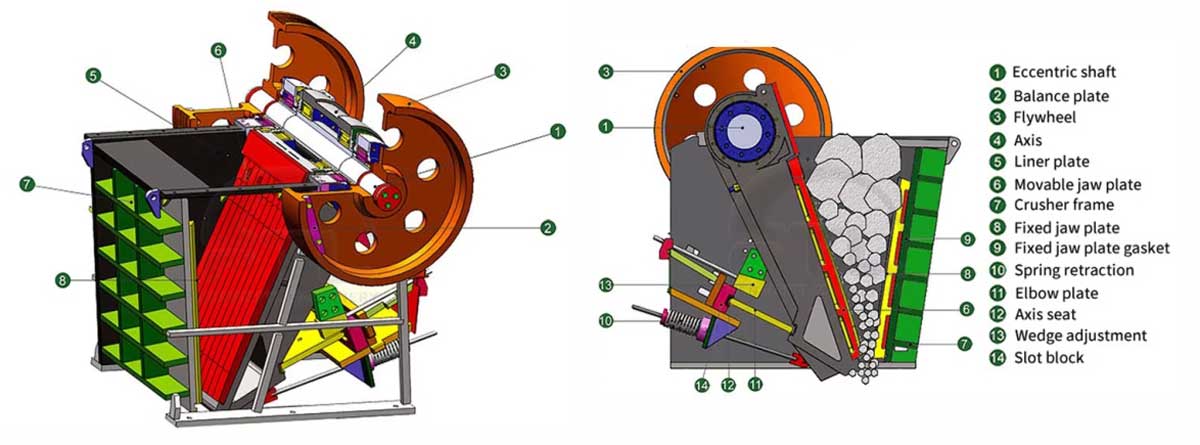
The jaw crusher is mainly composed of a frame, jaw plates (moving jaw and fixed jaw), side guard plates, and transmission parts (motor, pulley, eccentric shaft, etc.). The jaw plate is its key component, and a crushing chamber is formed between the moving jaw and the fixed jaw, which is generally V-shaped.
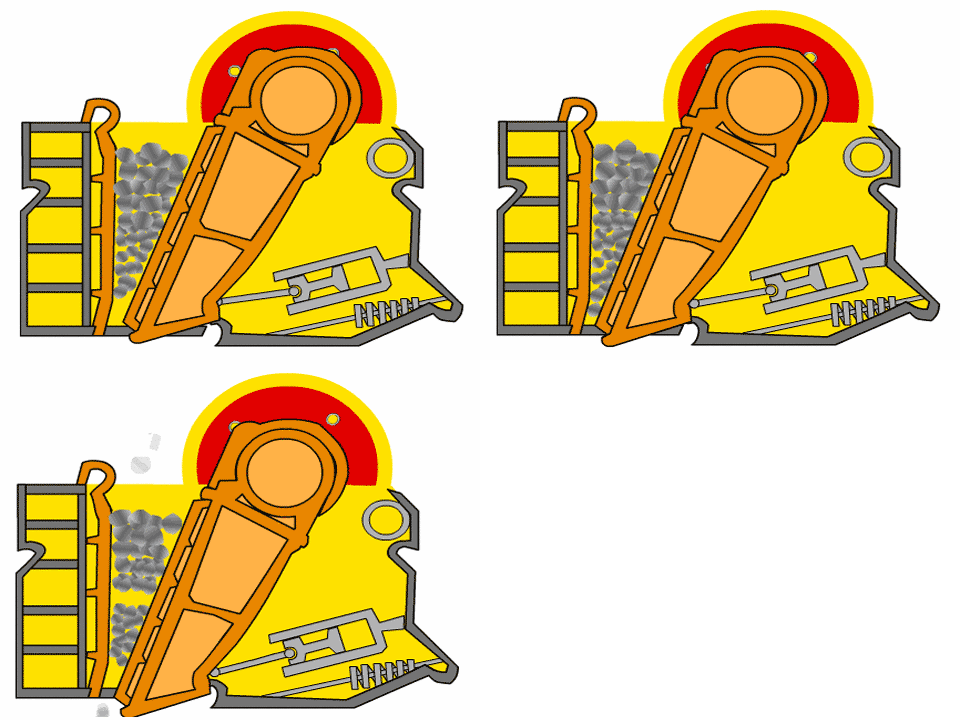
The working process of the jaw crusher is as follows: the motor drives the belt and pulley, and the eccentric shaft causes the moving jaw to perform periodic reciprocating motion. When the moving jaw rises, the angle between the toggle plate and the moving jaw increases, thereby pushing the moving jaw plate closer to the fixed jaw plate. At this time, the material entering the crushing chamber is crushed by squeezing, rubbing, and grinding. When the moving jaw descends, the angle between the toggle plate and the moving jaw decreases, and the moving jaw plate leaves the fixed jaw plate under the action of the pull rod and spring. At this time, the crushed material is freely discharged through the discharge port at the bottom of the jaw cavity under the action of gravity. The material in the upper part of the crushing chamber that has not been crushed to a small enough size will then fall to the lower part of the crushing chamber and continue to be crushed by the action of the movable jaw plate and the fixed jaw plate. This type of crusher has a large feed opening and is suitable for processing large pieces of limestone. The general feed particle size can reach about 1 meter, and the discharge particle size can be adjusted from a few millimeters to tens of centimeters according to the size of the discharge opening.
The jaw crusher reduces large-sized rocks, ores or other materials through compression to meet the needs of subsequent production processes.
Jaw Crusher Types
With a history of nearly 200 years, jaw crushers are one of the most “classic” types of crushers. Jaw crushers have undergone technological improvements over the years, making them more durable, increasing operating speeds, and reducing clogging. There are two common types of jaw crushers. These are double toggle and single toggle. The difference between these two configurations is the way the movable jaw moves.
- Double Toggle Jaw Crusher: Double toggle-motion jaw crushers like the Black model (named after Eli Whitney Black, the inventor of the first successful mechanical jaw crusher) have long been the standard choice for crushing hard, abrasive rock and sticky materials. These jaw crushers are highly energy efficient. The top shaft design further reduces wear on the crusher surface.
- Single Toggle: Single toggle-motion jaw crushers are more compact than double toggle designs, and although they were once unable to accept larger feed sizes, they generally run faster. Technological advances have solved the feed size problem, and today these machines are popular for their fast working efficiency. However, they do produce more wear than double toggle types. However, the widespread availability and economical availability of wearing parts have not prevented the popularity of the single toggle plate design.
Consumable parts of the jaw crusher
Jaw plate
Moving jaw plate: installed on the moving jaw, as the moving jaw reciprocates, the material is squeezed and crushed, it is in direct contact with the material and has frequent relative motion, so it is more worn. The degree of wear is closely related to factors such as the hardness, particle size, and corrosiveness of the crushed material.
Fixed jaw plate: fixed on the frame of the crusher, cooperates with the moving jaw plate to complete the crushing of the material. The fixed jaw plate is also subject to long-term friction and impact of the material, and is also prone to wear. Generally speaking, the service life of the jaw plate varies depending on the material and the crushed material. When crushing softer materials such as limestone, the service life of the jaw plate is relatively long, while when crushing hard materials such as granite, the wear rate will accelerate.
Toggle plate
The toggle plate is an important component in the jaw crusher, which plays the role of transmitting power and insurance. On the one hand, it connects the movable jaw and the connecting rod, transmits the power of the connecting rod to the movable jaw, and pushes the movable jaw to perform crushing work; on the other hand, when unbreakable materials (such as iron blocks, etc.) enter the crusher, the toggle plate will break due to excessive pressure, thereby protecting other important parts of the crusher from damage. Therefore, the toggle plate will be subjected to greater stress and friction during operation, and is prone to wear and breakage.
Guard plate
Located on both sides of the inner wall of the frame of the jaw crusher, the main function is to protect the frame from wear. During the crushing process, the material will constantly rub and collide with the inner wall of the frame in the crushing chamber. The guard plate can effectively block the direct impact of the material on the frame, thereby reducing the wear of the frame. Since the guard plate is in this harsh working environment for a long time, it is also a vulnerable part.
V-belt
The V-belt is used to connect the motor and the pulley of the jaw crusher, transmit the power of the motor to the crusher, rotate the eccentric shaft of the crusher, and drive the movable jaw to reciprocate. During the long-term use of the V-belt, it will wear, age, break and other conditions due to friction, stretching and other reasons, and needs to be checked and replaced regularly.
Need Some Help?
Our service team is here to help you 24/7. We can ship you limestone crusher and spare parts, and answer any questions about limestone crusher. Our jaw crusher can be customized according to your real situations, besides universal jaw crusher, we also offer other limestone crushers like impact crusher, cone crusher and hammer crusher etc. Whatever you need, we are here for you.
AGICO Cement Universal Jaw Crusher Specification
| Model | Feed opening (mm) | Max.feeding size (mm) | Adjusting range of discharge opening (mm) | Processing capacity (t/h) | Rotation speed of eccentric shaft (r/min) | Motor power (kw) |
| AGPE-150×250 | 150×250 | 125 | 10-40 | 1-3 | 250 | 4P 5.5 |
| AGPE-200×300 | 200×300 | 180 | 15-50 | 2-6 | 260 | 4P 7.5 |
| AGPE-200×350 | 200×350 | 180 | 18-70 | 3-10 | 260 | 4P 11 |
| AGPE-250×400 | 250×400 | 210 | 20-60 | 5-21 | 300 | 6P 15 |
| AGPE-400×600 | 400×600 | 340 | 40-100 | 16-64 | 275 | 6P 30 |
| AGPE-500×750 | 500×750 | 425 | 50-100 | 40-110 | 275 | 6P 55 |
| AGPE-600×750 | 600×750 | 500 | 150-200 | 80-240 | 275 | 6P 55 |
| AGPE-600×900 | 600×900 | 500 | 65-160 | 50-160 | 250 | 6P 55 |
| AGPE-750×1060 | 750×1060 | 630 | 80-140 | 110-320 | 250 | 8P 110 |
| AGPE-800×1060 | 800×1060 | 640 | 130-190 | 130-330 | 250 | 8P 110 |
| AGPE-830×1060 | 830×1060 | 650 | 160-220 | 150-336 | 250 | 8P 110 |
| AGPE-870×1060 | 870×1060 | 660 | 200-260 | 190-336 | 250 | 8P 110 |
| AGPE-900×1060 | 900×1060 | 685 | 230-290 | 230-390 | 250 | 8P 110 |
| AGPE-900×1200 | 900×1200 | 750 | 95-165 | 220-380 | 200 | 8P 110 |
| AGPE-1000×1200 | 1000×1200 | 850 | 195-265 | 315-500 | 200 | 8P 110 |
| AGPE-1200×1500 | 1200×1500 | 1020 | 150-350 | 400-800 | 180 | 6P 160-220 |
| AGPE-1500×1800 | 1500×1800 | 1200 | 220-350 | 500-1000 | 180 | 8P 280-355 |
| AGPEX-150×750 | 150×750 | 120 | 18-48 | 8-25 | 320 | 4P 15 |
| AGPEX-250×750 | 250×750 | 210 | 25-60 | 13-35 | 330 | 6P 22 |
| AGPEX-250×1000 | 250×1000 | 210 | 25-60 | 16-52 | 330 | 6P 30 |
| AGPEX-250×1200 | 250×1200 | 210 | 25-60 | 20-61 | 330 | 6P 37 |
| AGPEX-300×1300 | 300×1300 | 250 | 20-90 | 16-105 | 300 | 6P 55 |