
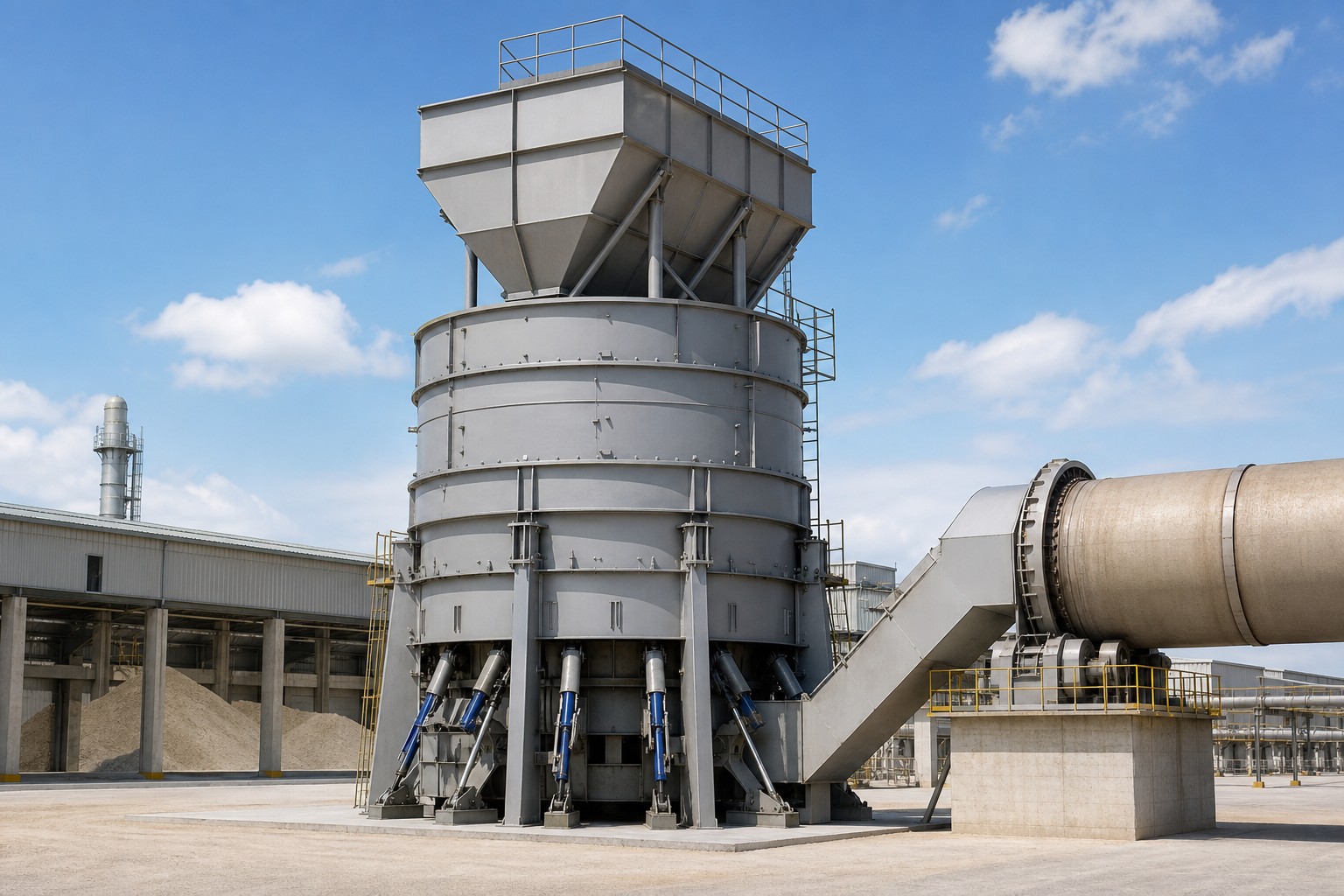
A vertical preheater recovers heat that a lime rotary kiln would otherwise send toward the exhaust treatment system. Sized limestone enters through a sealed feed chamber at the top, forms a moving bed inside the preheater, and meets hot kiln gas flowing upward. Before the stone reaches the kiln, its temperature can rise to 800°C or higher, depending on raw material, gas temperature and residence time. The rotary kiln then supplies less of the sensible heat required to bring the stone to calcination temperature.
For a new active lime line, this heat recovery reduces the thermal load on the kiln and helps raise system output without simply increasing fuel input. For a retrofit, it can convert an underused kiln-tail heat stream into useful process duty. AGICO Cement supplies the preheater as an engineered part of the kiln system, including the feed lock, pressure-resistant vessel, refractory lining, hydraulic pushers, discharge transfer, gas ducting, supports, instruments and control logic.
The equipment is normally applied to limestone or dolomite in the 10-50 mm range and matched to lime plants from approximately 200 to 800 TPD. Final dimensions are determined from the material test, required capacity, rotary kiln exhaust volume, pressure loss allowance and site arrangement. This project-specific approach is important: a preheater that looks adequate by diameter alone can still suffer poor gas distribution, bridging or excessive pressure drop if the material bed is not designed around the actual stone.
What AGICO Cement Delivers
AGICO Cement has supplied lime kilns, complete lime production lines and supporting equipment for more than 20 years. Our engineering scope begins with the process balance rather than a stand-alone equipment drawing. We review limestone chemistry and decrepitation, feed-size distribution, kiln capacity, fuel, exhaust temperature, dust loading and plant elevation before fixing the chamber area, bed depth, gas passages and discharge arrangement.
The result is a vertical preheater that arrives as part of a coordinated calcination system. Equipment interfaces, loads, expansion joints, hydraulic station capacity, control interlocks and refractory details are defined before fabrication. Customers can select equipment supply, installation guidance, commissioning support or a broader EPC package according to project responsibility.
Why Add a Vertical Preheater to a Lime Rotary Kiln?
Recover Kiln-Tail Heat Instead of Paying for It Twice
The hottest usable exhaust gas from the rotary kiln is directed through the limestone bed before dedusting. Counter-current contact provides a large heat-transfer surface without requiring a separate rotating drive. When the material enters the kiln already hot, the burner is not responsible for the full temperature rise from ambient conditions. The practical benefit is lower specific fuel demand, subject to system design and operating conditions.
Support More Stable Calcination
Uniformly preheated stone enters the kiln with a narrower temperature difference between particles. This reduces abrupt thermal loading at the feed end and gives the kiln operator a more stable starting condition for calcination. Stable feed temperature, feed rate and draft make it easier to manage free CaO, residual CO2 and lime activity targets.
Increase Useful Kiln Capacity
Part of the heating duty is completed outside the kiln shell, leaving more kiln residence time and burner capacity available for decomposition. Depending on the existing bottleneck, a retrofit can help unlock output that is currently limited by kiln-tail heat transfer. AGICO evaluates the fan, dust collector, cooler and material-handling equipment at the same time so the improvement does not shift the bottleneck downstream.
Compact Layout and Controlled Discharge
The vertical arrangement uses elevation instead of a long horizontal footprint. Multiple hydraulic pushers discharge material in controlled sectors, helping maintain a reasonably uniform bed and preventing one side from emptying faster than another. Individual pusher inspection points and replaceable wear parts simplify planned maintenance.
Create a Better Basis for Emission Control
Recovering heat can reduce fuel consumption per tonne of lime, which can lower combustion-related emissions for the same output. The cooler gas leaving the preheater also provides a more manageable inlet condition for downstream gas conditioning and baghouse equipment. The final emission result still depends on the complete combustion and dust-control system, not on the preheater alone.
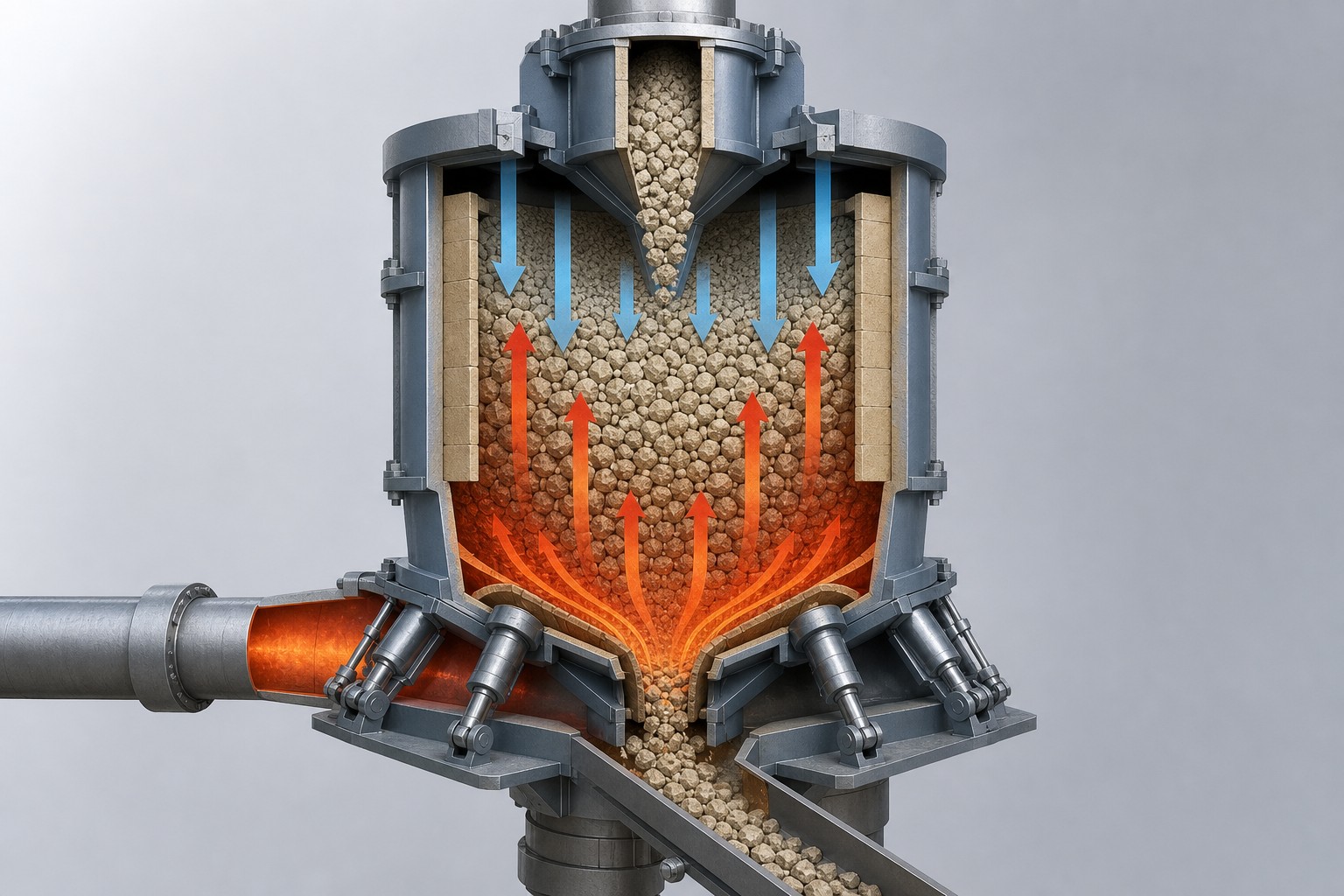
How the Vertical Preheater Works
1. Sealed feeding: Screened limestone enters the upper hopper through an air-locking feed device. Limiting false-air entry protects the heat balance and keeps the induced-draft fan from moving unnecessary cold air.
2. Moving-bed heat exchange: Stone descends gradually while hot exhaust gas from the kiln flows upward through designed gas passages. Heat transfers directly from gas to stone across the packed bed.
3. Controlled sector discharge: Hydraulic pushers operate in a programmed sequence around the lower chamber. The control system adjusts the stroke and frequency to maintain feed rate and bed stability.
4. Transfer to the rotary kiln: Preheated material moves through the discharge chute into the kiln feed end. Interlocks coordinate the preheater, kiln feed, draft fan and hydraulic station to avoid overfilling or an empty bed.
5. Gas cleaning: After releasing heat, the exhaust gas proceeds to the dust collection system. Temperature, pressure and oxygen readings help the operator verify heat exchange and detect abnormal air leakage or blockage.
Main Components
- Upper feed hopper and air-locking device for continuous feeding with limited false-air ingress.
- Steel shell and internal refractory/insulation system designed for temperature, pressure and thermal expansion.
- Gas distribution chamber and passages sized to balance heat exchange against pressure loss.
- Hydraulic pushers, cylinders and power unit for sector-by-sector material discharge.
- Discharge hopper, transfer chute and expansion interfaces connecting the preheater to the rotary kiln.
- Platforms, ladders, inspection doors and access points for safe operation and maintenance.
- Temperature, pressure, level and hydraulic instrumentation integrated with PLC/DCS control.
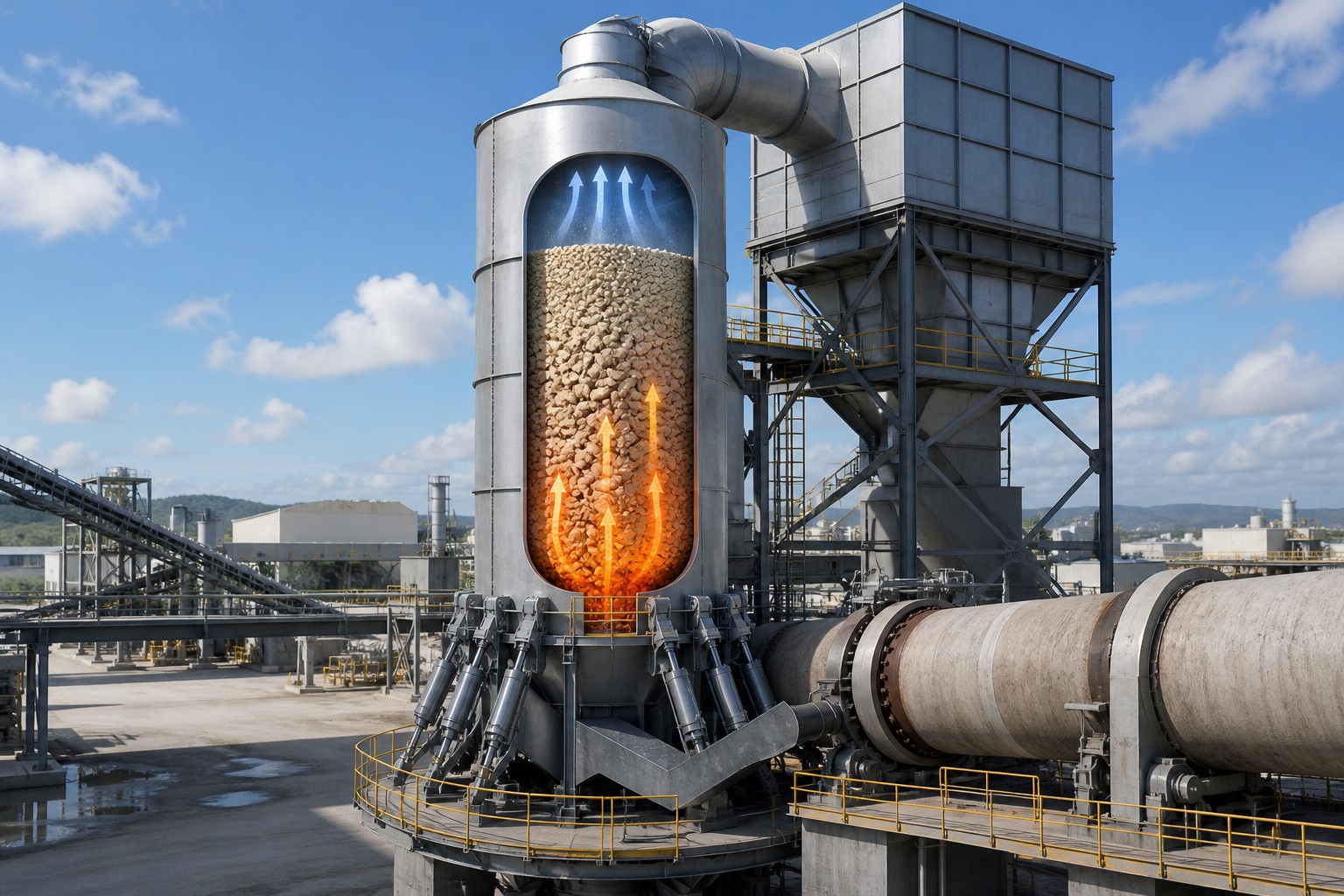
Preliminary Technical Parameters
Parameter note: The table is a preliminary selection range based on AGICO product-family references. Capacity, pusher quantity, motor power, vessel size, pressure loss, refractory specification and guaranteed outlet temperature must be confirmed from the final process calculation, material test and matched rotary kiln. They are not binding performance guarantees.
| Model | Nominal Capacity (TPD) | Feed Size (mm) | Preheat Temperature | Pusher Groups | Installed Power (kW) |
|---|---|---|---|---|---|
| VP-200 | 200 | 10-40 | ≥800°C | 6 | 15 |
| VP-300 | 300 | 10-50 | ≥800°C | 8 | 22 |
| VP-500 | 500 | 10-50 | ≥800°C | 10 | 30 |
| VP-800 | 800 | 10-50 | ≥800°C | 12 | 45 |
Applications
Active Lime Production Lines
In a rotary-kiln active lime line, the vertical preheater sits between screened limestone storage and the kiln inlet. It is particularly valuable where fuel cost is a major operating expense and a consistent high-activity product is required for steelmaking, chemical processing or environmental applications.
PCC and Calcium Carbonate Projects
PCC production requires controlled calcination before slaking and carbonation. Stable preheating helps the rotary kiln deliver a predictable quicklime feed to the downstream process, while heat recovery improves the economics of the integrated line.
Dolomite Calcination
A vertical preheater can also recover heat ahead of a dolomite rotary kiln. Dolomite behaviour, target calcination temperature and decrepitation differ from limestone, so gas velocity, residence time and refractory selection require a separate process review.
Existing Kiln Retrofit
A retrofit is practical when the existing kiln has recoverable exhaust heat and sufficient structural, draft-fan and gas-cleaning margin. A survey should confirm available elevation, foundations, duct routing, shutdown window and whether the current feed-size control is suitable for a moving bed.
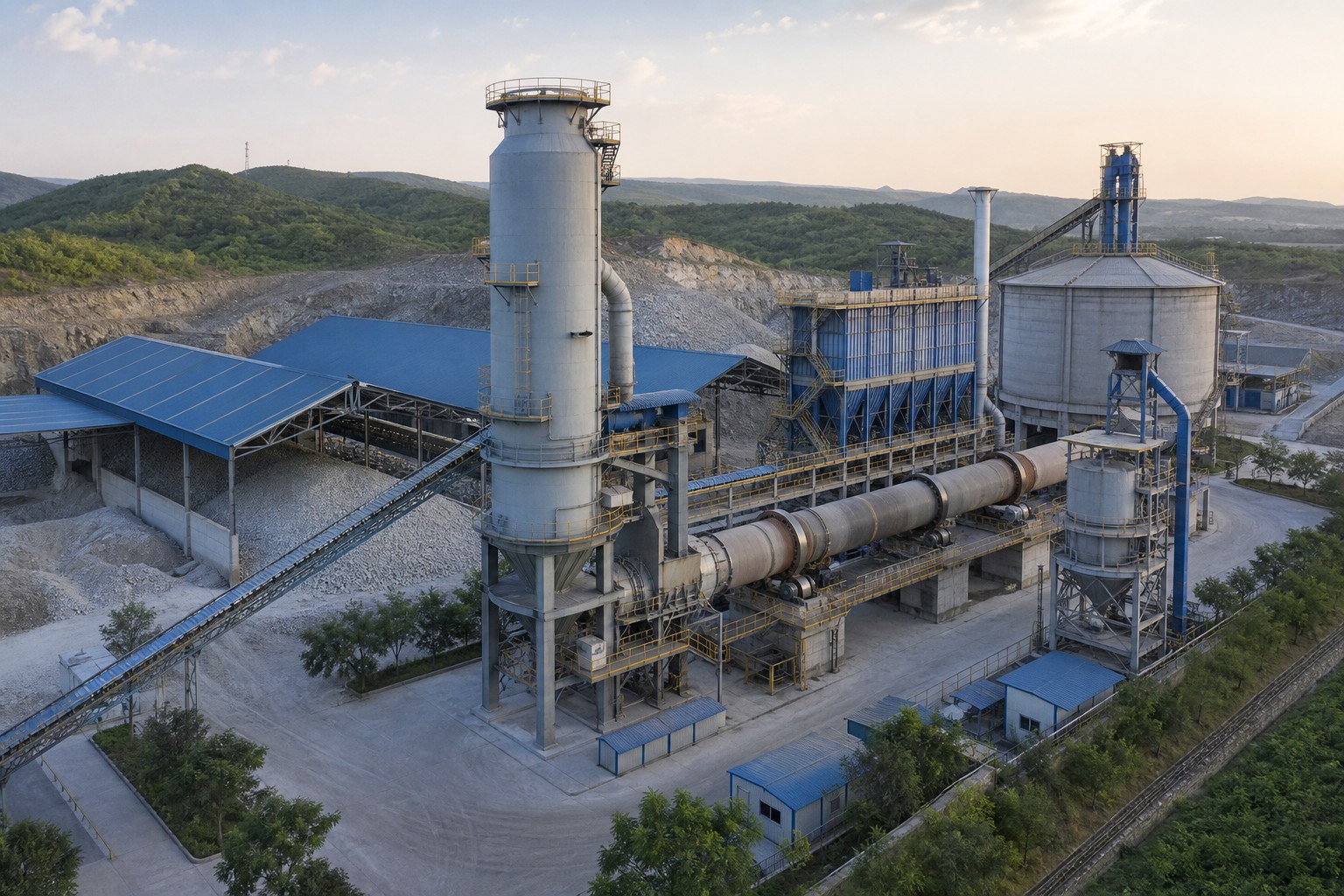
How to Select the Right Vertical Preheater
A reliable selection starts with six groups of project data. These inputs allow the preheater, rotary kiln and gas-handling system to be matched as one process.
Capacity and operating range: provide normal, minimum and peak kiln throughput rather than only nameplate output.
Material data: chemistry, bulk density, moisture, feed-size distribution, fines percentage, strength and decrepitation behaviour.
Kiln gas data: volume, inlet temperature, dust loading, oxygen, moisture and expected upset conditions.
Performance target: required material outlet temperature, permissible pressure drop and heat-recovery objective.
Site interfaces: available elevation, foundations, access, crane strategy, duct route and downstream dust collector capacity.
Control philosophy: stand-alone PLC or integration with the plant DCS, including alarm and interlock requirements.
For quotation, send AGICO Cement the above data together with the rotary kiln model and a plant layout. Our engineers can return a preliminary process scheme, equipment boundary, utility list and commercial proposal.
Vertical Preheater vs. Cyclone Preheater
The two names are sometimes mixed in general marketing copy, but they are not interchangeable. For a lime project using 10-50 mm stone, the moving-bed vertical preheater is normally the relevant configuration.
Vertical Preheater
A vertical moving-bed preheater is generally selected for lump limestone feeding a lime rotary kiln. The coarse material descends by gravity and exchanges heat directly with kiln exhaust.
Cyclone Preheater
A cyclone preheater is designed primarily for fine powder suspended in gas, as used in many dry-process cement systems.
ENGINEERED FOR LONG-TERM PERFORMANCE
Support Beyond Equipment Delivery
Reliability, Maintenance and Lifecycle Service
Preheater reliability depends on material consistency and access as much as on shell fabrication. AGICO designs wear and heat-exposed areas for inspection and replacement, provides access to pusher mechanisms, and defines lubrication and hydraulic maintenance points. During commissioning, operators learn how to read temperature and pressure trends, adjust pusher sequencing, identify bridging and respond to abnormal draft.
Lifecycle support can include installation supervision, refractory guidance, cold and hot commissioning, operator training, spare pusher seals and hydraulic components, shutdown inspection and retrofit optimization. For existing plants, a performance review can compare feed temperature, exhaust temperature, pressure loss and fuel use before and after adjustment.
Commissioning
Cold & hot start support
Training
Operator & maintenance
Retrofit Support
Performance optimization
Energy and Responsible Operation
The primary environmental value of a vertical preheater is practical heat recovery. Using kiln exhaust to warm limestone can reduce the fuel required per tonne of lime, conserve energy and reduce the amount of high-grade heat rejected from the process. A stable sealed feed system also limits false air, which otherwise increases fan load and enlarges the gas volume handled by the dust collector. Project claims should always be based on measured mass and heat balances rather than a universal savings percentage.
Quality Management
AGICO applies documented inspection to steel materials, welding, dimensional tolerances, hydraulic assemblies and trial operation. Refractory anchors, expansion allowances and shell interfaces are checked before shipment. The final project specification can be prepared around the purchaser’s applicable design, electrical and safety requirements; local code compliance, emission limits and site permitting remain project-specific and must be confirmed during engineering.
Inspection, commissioning and lifecycle support are coordinated around the operating realities of each lime plant.
FAQ
The preliminary product-family range is approximately 200-800 TPD. The practical capacity depends on limestone size, gas volume, permitted pressure loss and the matched rotary kiln.
A properly matched system can preheat limestone to 800°C or higher. The guaranteed value must be calculated from the actual kiln exhaust temperature, gas flow, material properties and operating rate.
Yes, when the kiln has recoverable exhaust heat and the site can accommodate the vessel, supports, ducting and feed elevation. Fan and dust-collector margins also need verification.
AGICO’s preliminary range is 10-50 mm. A narrow, controlled size distribution is preferable because excess fines raise pressure loss and uneven large stone can impair heat transfer.
Yes, but dolomite requires a separate process calculation. Its thermal behaviour, decrepitation and target calcination conditions differ from limestone.
Provide capacity, raw-material analysis and size distribution, rotary kiln data, exhaust gas conditions, site layout, elevation constraints, power standard and required supply scope.