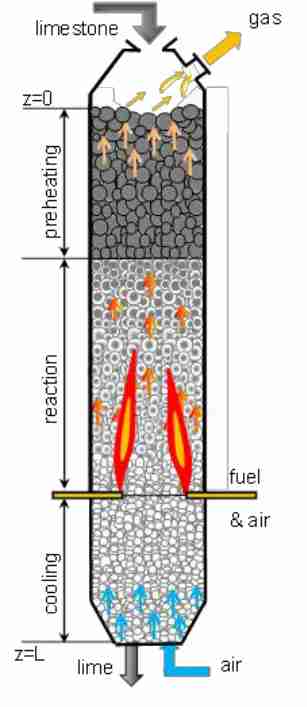
In 2014, our company and several major domestic iron and steel enterprises jointly introduced the lime shaft kiln and patented technology of Japan’s Sumitomo Metal, Kawai Lime, and Tanabe Chemical Machinery. The TTHN type high-efficiency environmental protection automatic lime shaft kiln is adopted. Since the first kiln was ignited and put into production, nearly 100 lime shaft kilns have been built at home and abroad. In recent years, This new type of shaft kiln is favored by large and medium-sized state-owned and private individual enterprises with its advantages of remarkable energy saving, environmental protection compliance, high degree of automation, high quality of finished products, low construction cost and short construction period.

Technological Characteristics of TTHN Lime Shaft Kiln
1. The kiln has a unique design and is energy-saving in operation
(1) The furnace body is designed with five layers of high alumina brick + light insulation brick + insulation filler + insulation fiber + steel furnace shell, 1000mm thick, the outer furnace shell is light and good, and the design life of the refractory insulation layer in the furnace is over 5 years. In order to use energy efficiently, the whole kiln body is fully sealed, which greatly reduces the heat dissipation from the upper and lower parts. Combustion-supporting air is blown from the lower part of the kiln body, passes through the cooling zone, becomes hot air through heat exchange, and is blown into the furnace, and the upper raw material is added to the preheating zone for heat exchange with the rising high-temperature flue gas. The temperature of the discharged finished ash is controlled below 40 ℃, and the temperature of the flue gas discharged from the upper part is below 140 ℃. After actual measurement, the calorific value and utilization rate of the fuel are above 80% (generally, the kiln is below 40-60%).
(2) Special equipment such as double-groove distributor has peculiar functions, which ensures the energy saving of the equipment.
The kiln body is equipped with a double-slot distributor (TTSC type), which can mix limestone and coal evenly on the material surface due to its special structure. In the calcination zone, the coal is heated evenly everywhere, which avoids over-burning and nodules caused by high temperature in places with more coal due to uneven distribution, and raw burning in places with low temperature, which not only wastes fuel but also reduces the quality of finished ash. The distributor has been tested by many users at home and abroad, and each ton of ash can save more than 15Kg of coal compared with other distribution methods.
(3) The scientific operation mode ensures energy-saving operation.
The power used in the production of the kiln, like the high-pressure fan, the hoist feeding motor, the rotary ash machine motor, the spreader motor, the various belt conveyor motors and other powers that need continuous operation in more than ten places are all driven by frequency conversion. The phenomenon of large horse-drawn trolley and no-load operation saves more than 40% of electric energy on average.
(4) The dust removal design is scientific, which ensures the dust removal and energy saving.
There are six places for dust removal, all of which are designed with microcomputer-controlled electric valves. In the post dust removal, the required air volume is about 50,000 ㎡/h, and the power is 80KW. In the design, each valve is opened and closed to realize program control, saving electric energy up to 70%, which greatly reduces the power of the dust removal induced draft fan configuration.
2. The flue gas and dust of the dust removal system are ingeniously matched, and the flue gas is discharged up to the standard
The new FSD type offline ash cleaning pulse bag filter + glass fiber reinforced plastic desulfurization tower is selected to solve the dust, SO2 and NOx in the flue gas, and achieve the emission standard. The flue gas from the top of the furnace is collected through the pipeline, and after being filtered and dedusted by the bag type, it is sent to the FRP desulfurization tower for desulfurization by the induced draft fan. Several kilns have been tested by the environmental protection department for the dust removal effect. This project adopts a special dust removal process, that is, the dust are mixed together to remove dust, which not only solves the difficulty of dust removal due to high temperature of flue gas, but also solves the problem of coal tar from burning coal, which sticks to the bag and blocks the filter hole during dust removal.
3. The technological process layout is compact and reasonable
The kiln is composed of feeding system, mixing part, distributing part, kiln body part, ore discharging part, finished product warehouse, dust removal system, etc.A single kiln covers an area of about 2 mu (40x40m), with a compact and reasonable structure.
4. The process principle is scientific, and the waste heat is effectively used
The qualified raw materials and fuels are accurately weighed by an electronic scale with an accuracy of 3‰, and then uniformly mixed by the intermediate bucket and the belt conveyor, and the mixed material is transported to the furnace along the inclined bridge by the 1.5㎡3 single bucket hoist. The top receiving hopper is evenly and quantitatively fed by the electromagnetic vibrating feeder, and the furnace distribution is completed by the double-slot distributor on the top of the furnace. The material overcomes the buoyancy of the gas flow by its own weight and moves downward slowly, and successively passes through the preheating zone, the calcining zone and the cooling zone.
During the descending process of the charge, complex heat exchange is carried out with the hot gas, and it is accompanied by the decomposition of limestone and the development and growth of quicklime grains. The tower ash extractor and the sealed ash unloader will discharge the lime to the belt conveyor outside the furnace without leakage of combustion-supporting air. After the elevator and screening, the lime of ≤ 5mm and > 5mm will be discharged into different materials warehouse respectively.
Combustion-supporting air is blown into the furnace from the lower part of the furnace body by a high-pressure fan, and rises from the lower part to the top of the furnace against the resistance of the material particles. A slight negative pressure area (about -10Pa) is formed above the material surface in the kiln. This slight negative pressure ensures smooth airflow in the furnace, which is very beneficial to the decomposition of limestone in the calcined zone. The exhaust fan will introduce all the flue gas into the dust collector for purification, and then discharge it into the atmosphere from the chimney up to the standard.
5.The kiln has established a scientific guiding ideology based on raw materials
Qualified raw fuel is very important to the quality of calcined lime. If the limestone particle size is uneven, the difference is too large or there are too many impurities, the charge will segregate in the furnace, resulting in disordered airflow, unstable calcination zone, and raw burning, serious burning, resulting in serious furnace tumor. If the coal particle size is unqualified, if the particle size is too small, there will be insufficient heat during the decomposition of CaCO in the calcination zone, which is easy to cause inclusion. If the particle size is too large, it will still burn when it reaches the cooling zone, resulting in excessively high ore discharge temperature, which not only wastes fuel, but also makes ore discharge difficult. Without qualified and stable raw materials and fuels, qualified products cannot be produced. Therefore, with qualified fuels as the basis, coupled with advanced technology, the high quality of products can be guaranteed.
6. The original and fuel weighing and mixing design is novel and easy to adjust
The weighing device of the mixing system adopts an automatic weighing device with automatic control, and the accuracy is less than 3‰. During weighing, the vibrating feeder controlled by frequency conversion divides the material into two times, and feeds the material at a faster speed to 90%, and then feed at a slower speed to 100%, the limestone error is within 3Kg, the coke (coal) error is within 0.21Kg, and the last weighing error can be automatically compensated next time. In the process of mixing materials, the transmission device is also controlled by frequency conversion speed regulation. Limestone and coke (coal) are first placed in the middle hopper, and then mixed by a belt with a width of 800mm within a specified time (limestone is below, coke above) through the chute and into the upper hopper. The two must be completed at the same time, the flow rate of the two has adjustment means, and the entire weighing and mixing process is automatically controlled by a programmable controller (PLC). There are monitoring devices on site for monitoring, and the control system adopts automatic and semi-automatic redundant control, which can be connected to the computer for dynamic picture display, alarm, printing and other functions.
7. The structure of the material spreading equipment is novel, and the material in the kiln is mixed to the extreme
After a uniform mixture, it is lifted to the top of the furnace by a single bucket elevator and put into the receiving hopper. After the probe is raised to the upper part and the feeding signal is sent, the flapper valve is opened, and the material is put into the distributor by the vibrating feeder. When feeding into the distributor, the distributor rotates continuously, one side rotates, the other side opens and closes, until a batch of materials is finished, and stops rotating (about 5-7 circles per feeding). The feeding port of the distributor stops at a different position every time the material is distributed. When the next batch of materials starts to be distributed, the feeding port will start to rotate from the new position.
8. Uninterrupted air evenly discharges ash to maintain a good furnace condition
The ash output of the kiln adopts a ash output structure composed of a tower ash extractor and two-stage sealing valve. The tower-type ash extractor completes the ash extraction method in which the edge drives the center through the cooperation of the wind tower and the scraper, and the material falls into the two-stage seal. In the valve, the two-stage valve discharges the ash out of the kiln through the alternate work of the upper and lower baffles. It can not only ensure the stable decline of the material but also realize the non-stop air ash discharge, which is very consistent with the calcination principle, and greatly reduces the nodule hanging on the wall caused by the slow movement of the middle and lower parts of the kiln caused by the center driving the two sides to discharge ash in most existing processes. It is the guarantee of high quality and high yield of lime.
9. The furnace condition control method is advanced, and it only takes 3-4 hours to adjust the deviation
The tower ash extraction machine has a unique local ash extraction capability. When the furnace condition is slanted, the scraper can realize ash extraction in any area, and many places with poor airflow can make the fire gradually uniform. Through the cooperation of feeding and ash, the partial burning kiln condition can be corrected in only 3-4 hours.
10. The level of automated production is high, and single-person operation is normal for production
Feeding from raw material hopper—electronic weighing—mixing ingredients—furnace top charging—skimming—ash discharge—finished product feeding bin is fully automated. When it is necessary to adjust the parameters of furnace conditions, it can only be operated on the microcomputer in the industrial control room.