Calcination is a crucial process in limestone production, and its quality greatly affects the quality of subsequent products. A lime kiln is used to calcine limestone, and during its use, some problems are inevitable, with nodulation being a common one. So, how does nodulation occur in limestone calcination?
The influence of limestone raw material composition
In addition to the main component calcium carbonate (CaCO3), limestone also contains some impurities, such as magnesium carbonate (MgCO3), and the oxides of iron, aluminum, and silicon. MgCO3 and the oxides of iron and aluminum in limestone are strong fluxing agents. Their presence during calcination can easily react with CaO to produce easily fusible compounds such as XCaO·SiO2, XCaO·Fe2O3, XCaO·Al2O3, and CaSO4. These compounds generate liquid coalescents at high temperatures in the calcination zone of the lime kiln, which will stick the limestone together into large masses and sinter it into nodules. Some nodules will stick to the lime kiln wall, causing nodulation accidents.
Therefore, based on the mechanism of lime kiln nodules, limestone with low impurity content such as SiO2, Fe2O3, Al2O3, and MgCO3 should be selected as raw materials before calcination.
The impact of limestone raw material particle size
The particle size of limestone has a significant impact on the calcination rate of lime. Large particle sizes can prolong the residence time of materials, affecting the capacity of the lime kiln. Conversely, the smaller the particle size of limestone, the shorter its residence time in the lime kiln. However, reducing the particle size of limestone also has its limits, as excessively small particle sizes can increase the kiln’s resistance, disrupt gas distribution, damage the calcination process, result in partial burning, local high temperatures, or generate nodules. This can increase fuel consumption and decrease the production capacity of the lime kiln, as well as the CO2 concentration in the kiln gas.
Therefore, the particle size of limestone should be uniform, and the kiln area should be stable. This is conducive to the smooth operation of the lime kiln and the improvement of the decomposition rate.
Impact of the content of fines in limestone raw materials
The content of fines in limestone raw materials also affects the formation of nodules in the lime kiln. The higher the content of fines in the limestone raw material entering the kiln, the easier the material is to participate in the reaction, melt, or bond to the kiln wall, which can easily lead to the formation of kiln nodules. Generally speaking, if there is more fine powder in the limestone raw material, it means there are more impurities, as mentioned above. These impurities are more likely to react with CaO, generating various low-melting-point compounds that cause the limestones to bond together, forming kiln nodules.
The influence of calcination temperature
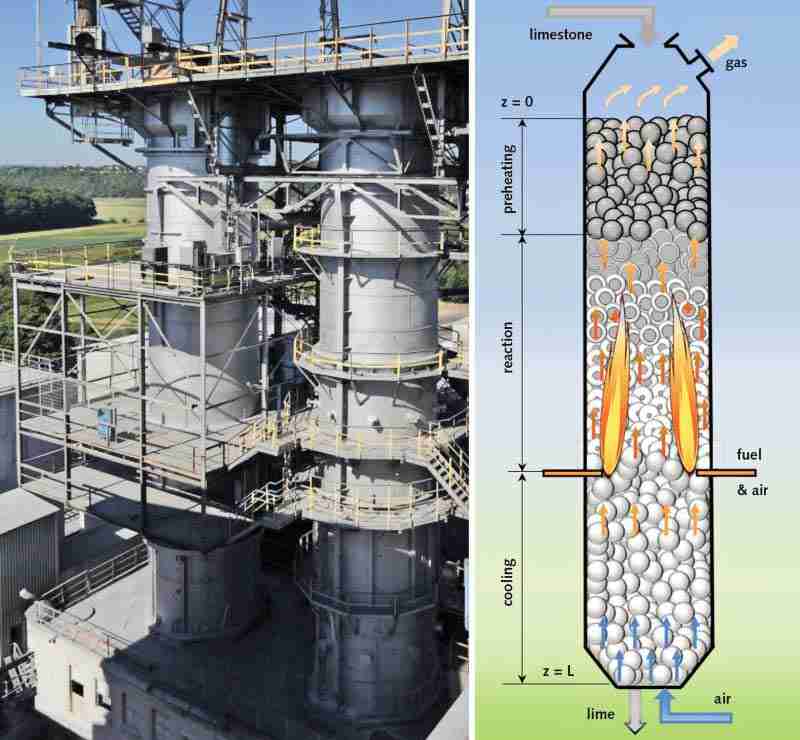
Improper control of the calcination temperature can easily result in the formation of nodules. This is because the higher the calcination temperature, the easier it is for low melting point substances in the material to melt into a liquid phase, causing the lime to stick together and gradually form hanging-wall nodules on the kiln wall. Moreover, at higher temperatures, the various components in the material are more likely to react with each other, or with the kiln lining, to generate more low melting point substances, thus promoting the formation of nodules.
Therefore, in the calcination process, the calcination temperature should be reasonably controlled based on the impurity content. Generally, for limestone with high CaCO3 content, the calcination temperature should be controlled at about 1300℃, while for limestone with low CaCO3 content, the calcination temperature should be controlled at 1050-1150℃, and for limestone with high MgCO3 content, the calcination temperature should be controlled below 1050℃. Of course, such temperature control is not always fixed and should be adjusted as necessary based on the quality of the finished product.
The effects of the length of the calcination zone
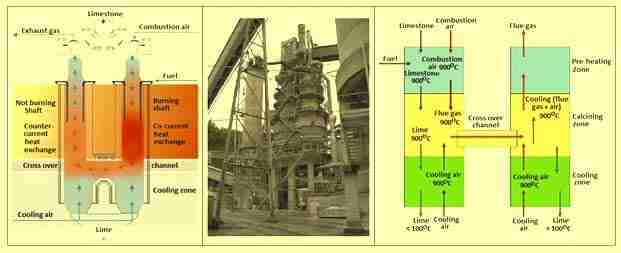
The actual length of the calcination zone in the kiln also affects the temperature inside the kiln. When the calcination zone moves down, it causes low top temperature, high ash temperature, low CO2 concentration in the discharged ash, and high lime burning rate. Moving the calcination zone up causes high top temperature, high ash temperature, high CO2 concentration, and high lime burning rate. Stretching the calcination zone causes high ash and top temperatures, uneven firing, and scattered temperature, resulting in lime burning. Shortening the calcination zone causes low top and ash temperatures, too low CO2 concentration, and lime burning. If the kiln temperature is increased blindly under these circumstances, overburning of the lime occurs, leading to the formation of kiln rings.
The effects of coke size
The amount of fuel used is critical to the decomposition of limestone during calcination. A low ratio of fuel to limestone results in insufficient calcination, leading to serious lime burning in the lime zone. Conversely, a high coke ratio increases fuel consumption, correspondingly increases the amount of air required for combustion, and also increases the amount of nitrogen brought in. This can result in high temperatures during ash extraction and gas emission, as well as severe ash burning, and can lead to phenomena such as ash extraction belt fires, kiln rings, and excessive air volume.
In addition, other factors such as the size of the air supply and production operations can also cause kiln rings. During production operations, workers should receive training to ensure that they have the necessary technical skills. They should strictly control the technical conditions such as the top temperature, ash temperature, and lime layer height. They should also ensure that the feeding and ash removal are done on schedule to maintain the height and temperature of the material layer and the position and temperature of the calcination zone, thus avoiding the occurrence of kiln ring problems.
A comprehensive approach is needed to avoid the problem of kiln rings in limestone calcination. By selecting high-quality limestone raw materials, paying attention to the size and powder content of the limestone, and controlling the calcination temperature, calcination zone length, coke ratio, and other factors through adjustments to the raw materials and process control, the occurrence of kiln rings can be reduced.