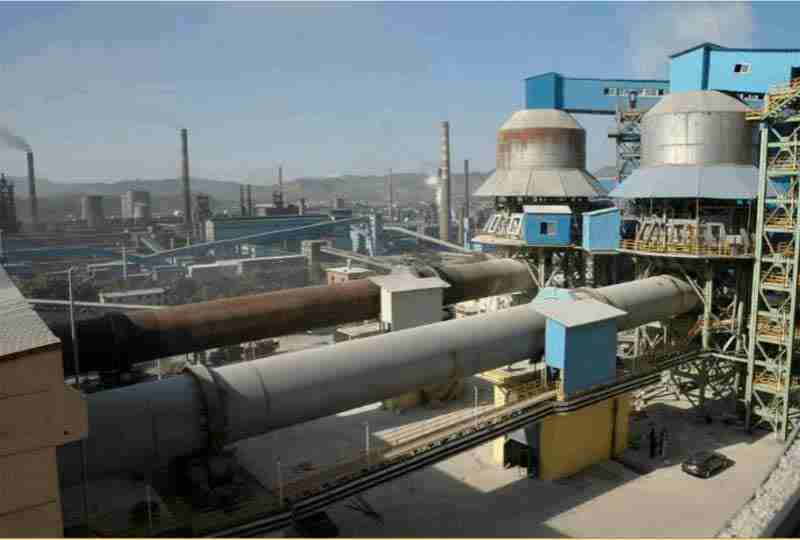
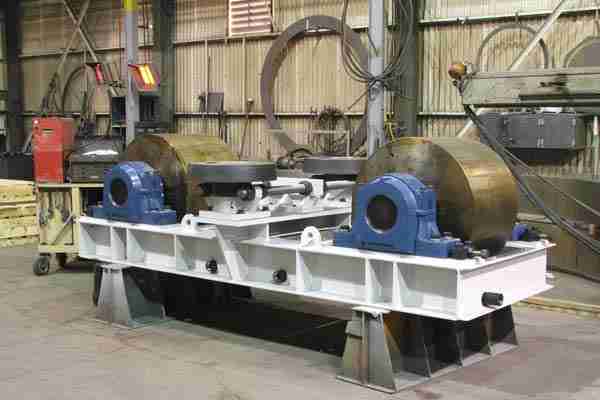
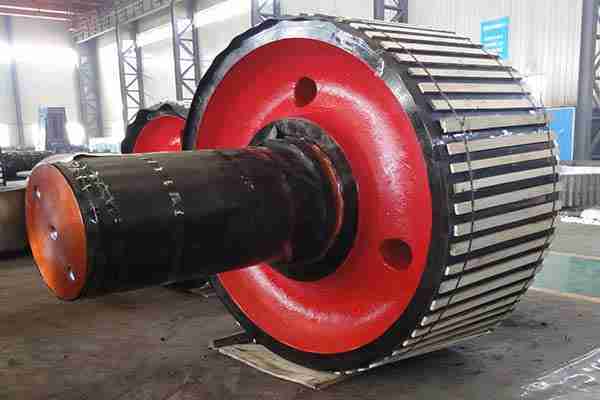
The support wheel and support wheel shaft or called wheel axle are crucial components of the rotary kiln, supporting the entire weight of the rotary kiln together with other support wheels. They have high value and a long manufacturing cycle, making replacement difficult. If the support wheel shaft breaks, it can cause significant losses to the enterprise’s production, and therefore it must be taken seriously. This article explains the causes and prevention of support wheel shaft fractures.
Causes of support wheel shaft fractures
The support wheel and shaft are generally assembled using a hot or cold method, tightly fitting the shaft and support wheel together. As a component that is contained, the support wheel shaft will receive a lot of pressure and produce significant friction, which can cause it to elongate and become loose with the pressure from the support wheel. Since the support wheel supports all the weight of the kiln through the shaft, the shaft bears a lot of shear stress. Furthermore, since the support wheel is a rotating component, it is also subject to alternating stress. Additionally, it is subject to temperature stress and frictional interference, making the stress complex. From the perspective of stress and other factors, the following describes the causes of support wheel shaft fractures.
Unreasonable matching of the support wheel and shaft
The interference fit between the support wheel and shaft is generally between 0.0006 and 0.001 times the diameter of the shaft to ensure that the support wheel and shaft do not become loose. However, this interference fit can cause the shaft to neck down at the end of the support wheel hole, resulting in stress concentration. Therefore, it is not difficult to imagine that the shaft may break at this location, and in fact, it often does.
Fatigue fracture
Since the support wheel of rotary kiln is subjected to complex stress, if the support wheel and shaft are considered as a whole, the maximum bending stress and shear stress that the shaft bears are at the corresponding position at the end of the support wheel hole under alternating load, making it prone to fatigue. Therefore, the fracture also occurs at the end of the joint between the support wheel and shaft.
Manufacturing defects
The support wheel shaft usually undergoes a process of steel ingot or round steel forging, machining, and heat treatment. If a defect in the middle of the process is not detected, such as impurities in the steel ingot, forging scale, or microcracks during heat treatment, these defects not only limit the load-carrying capacity of the shaft but also cause stress concentration. This is the source of the problem. Once the crack expands, the fracture is inevitable.
Temperature stress or improper loading
Large tiles in the rotary kiln often cause heat production faults. If the operation and maintenance are improper, surface cracks are likely to occur on the support wheel shaft. When the tile produces heat, the temperature of the shaft is undoubtedly high. If the shaft is rapidly cooled, the surface of the rapidly contracting shaft can only release huge shrinkage stress through cracks since the inside of the shaft cools slowly. At this time, surface cracks will produce stress concentration, and under the action of alternating stress, once the crack appears and expands, it will break at a certain point. The same applies to excessive stress on the support wheel, such as improper adjustments, which can cause excessive stress on a particular section of the shaft or axis, leading to the support wheel shaft breaking.
Prevention of fracture of the support wheel axle
The causes of support wheel axle fracture have been discussed above, and now we will talk about the prevention methods based on these causes.
Different interference fits between the support wheel and the axle bearing area
Due to the large interference fit between the support wheel and the axle, the axle will experience significant necking at the end of the support wheel bore after thermal expansion and contraction during installation. This results in excessive stress concentration. Therefore, during the design, manufacturing, and installation process, the interference fit at the two ends of the support wheel bore (within a range of about 100mm) should be gradually reduced from the inside out to alleviate the occurrence of necking, and the reduced amount can be gradually decreased to one-third to one-half of the intermediate interference fit, thereby avoiding or reducing the occurrence of necking.
Comprehensive inspection to eliminate defects
Defects can reduce the bearing capacity of the axle and also cause stress concentration, often leading to fracture accidents, which poses great danger. Therefore, defects of the support wheel axle must be detected in advance. For example, material selection should be inspected by non-destructive testing before processing to ensure the selection of materials without problems. During processing, non-destructive testing should also be conducted to eliminate defects, ensure the intrinsic quality of the axle, and guarantee the processing accuracy while eliminating crack sources and stress concentration sources.
Reasonable adjustment of the kiln to reduce the additional load
Multiple support wheel axles support the weight of the entire kiln, resulting in a large load. Improper installation or maintenance adjustment may cause uneven load distribution. When the position of the support wheel is inconsistent with the kiln’s centerline, a certain support wheel will bear excessive force. When the axis of the support wheel is not parallel to the kiln’s centerline, the force on one side of the axle will increase. Excessive stress may cause overheating of the large tile and damage the axle due to stress concentration. Therefore, maintenance and adjustment of the kiln must be taken seriously, and additional load should be avoided or reduced to ensure the smooth operation of the kiln. During maintenance, avoid heating or welding on the axle and avoid grinding the axle with a grinding wheel to reduce damage to the axle.
Do not rapidly cool the hot axle during operation
During operation, the large kiln may cause the large tile to overheat due to various reasons, causing production losses. Some units tend to adopt rapid cooling to reduce the temperature. However, this can easily cause micro-cracks on the surface of the axle. Therefore, a slow cooling method should be adopted to avoid rapid cooling.