Ball mills can be divided into many types according to different designs and uses, different operating methods, etc. Different ball mills have different working principles and application ranges. When choosing daily, you can choose the most suitable ball mill according to your needs and the different hardness of the raw materials, the final grinding particle size, etc. Here are some common classifications of different types of ball mills. People generally accept these classifications.
Types of Ball Mill
Classification by Cylinder Shape
Horizontal ball mill
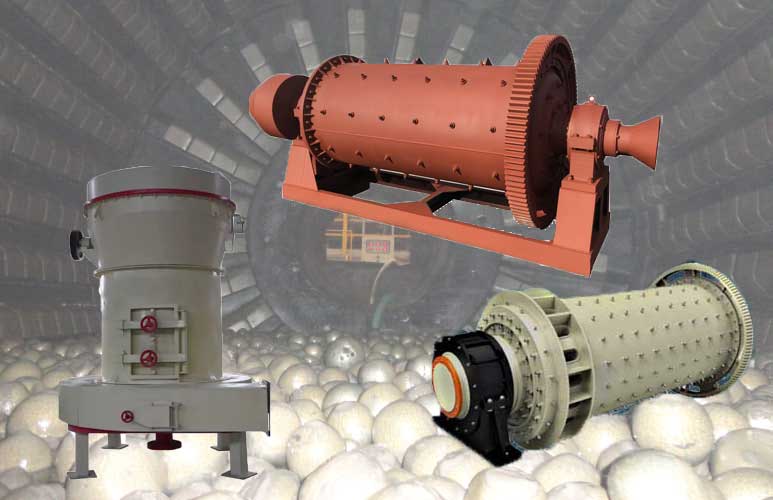
It is the most common type of ball mill. The cylinder is usually placed horizontally and is mainly composed of a cylinder, end cover, bearing, transmission large gear ring, pinion, motor, reducer, and other parts. The cylinder is a horizontal cylinder with end cover seals at both ends. The inner wall of the cylinder is usually lined with wear-resistant materials, such as manganese steel lining, etc., to reduce the wear of the cylinder. When the motor drives the cylinder to rotate through the reducer, the steel balls and materials in the cylinder are brought to a certain height under the action of centrifugal force and friction and then fall. The material is gradually crushed under the impact and grinding of the steel balls. The material enters from the feed port at one end of the cylinder, and as the cylinder rotates, it is discharged from the discharge port at the other end after multiple grinding. A horizontal ball mill is more suitable for large-scale production. It is widely used in mining, building materials, chemicals, metallurgy, and other industries, for grinding various ores, cement clinker, refractory materials, etc. Limestone ball mill is generally the horizontal ball mill model.
Vertical ball mill
This ball mill has a vertical structure, and the cylinder is placed vertically. Its structure is quite different from that of the horizontal ball mill. It generally includes a grinding cylinder, agitator, transmission device, and other parts. There is a discharge port at the bottom of the grinding cylinder and a feed port at the top. The agitator is installed in the grinding cylinder to drive the steel balls and materials to move. The material enters the grinding cylinder from the top, and the agitator drives the steel balls to move in the vertical direction to grind the material. The ground material gradually settles to the bottom under gravity and is discharged from the discharge port. Because the material’s movement path in the vertical direction is relatively short, and the stirring action of the agitator makes the material and the steel ball contact more fully, more efficient grinding can be achieved in some cases. It is widely used in some occasions where the product particle size requirements are high, the material viscosity is large, or fine grinding is required. For example, in pigment, coating, electronic material, and other industries, it is used to grind fine materials such as pigments and ceramic powders to obtain more uniform and finer products. Suitable for small experiments and some special processes.

Classification by Discharge Method
Grate discharge ball mill
A grate plate is provided at the discharge end of the cylinder. The grate plate is composed of many fan-shaped holes. Its function is to prevent the discharge of steel balls and coarse particles while allowing the fine materials to pass through. There is also a lifting device behind the grate plate, such as a spiral lifting plate, which is used to lift the fine materials and discharge them from the cylinder. During the grinding process, the materials are gradually ground by the steel balls, and the fine particles are discharged through a grid-shaped screen. The steel balls and the unground coarse particles remain in the cylinder and continue to be ground. This discharge method can effectively prevent the steel balls and coarse particles from being discharged too early and improve the grinding efficiency. It is often used in the first stage of coarse grinding, suitable for processing materials with higher hardness and larger particle size, such as coarse grinding of iron ore, grinding large pieces of iron ore into smaller particles, and providing suitable raw materials for subsequent fine grinding or ore dressing operations.


Overflow ball mill
The two ends of the overflow ball mill are open, and the ground materials are discharged through the mill under the action of gravity, which is suitable for the fine grinding process. The discharge port of the cylinder is higher than the lowest position in the cylinder, and there is no grate plate structure. During the grinding process, the material and the steel ball are mixed and ground in the cylinder. As the grinding progresses, the material is gradually ground and forms a slurry. When the liquid level of the slurry reaches the discharge port position, it will automatically overflow and enter the subsequent process flow. This discharge method is relatively simple, but the particle size control of the ground product is not as accurate as that of the grate discharge ball mill. It is generally used for the second stage of fine grinding, or in occasions where the product particle size requirements are not particularly strict. For example, in some small mineral processing plants, when the grinding accuracy of the ore is not high, an overflow ball mill is used to grind the ore.

Classification by Grinding Media
Steel ball mill
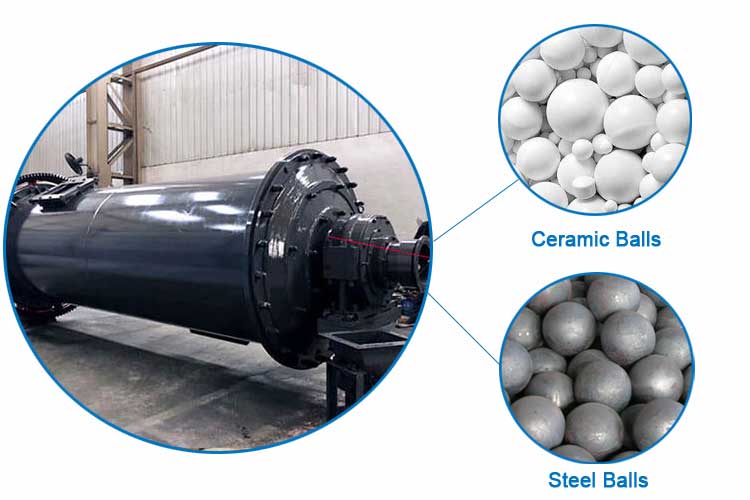
Steel balls are used as grinding media. The size, material and filling rate of the steel balls will be selected according to the characteristics of the materials and grinding requirements. The diameter of the steel ball is usually between a few millimeters and tens of millimeters. The material is generally carbon steel, alloy steel, etc., with high hardness and wear resistance. It is suitable for grinding harder materials. During the rotation of the cylinder, the steel ball is brought to a certain height and then falls down, crushing the material through impact and grinding. The steel ball mill is the most widely used type of ball mill. It can be used in almost all industries that need to grind solid materials, especially for grinding ores and block materials with higher hardness.
Ceramic ball mill
Ceramic balls are used as grinding media. Ceramic balls have the advantages of high hardness, good wear resistance, strong chemical stability, etc., and will not cause metal pollution to the ground materials. The material of the ceramic ball can be alumina, zirconium oxide, etc., and its density is generally smaller than that of the steel ball. It is suitable for industries with high requirements for product purity, such as chemicals and food. The working principle is similar to that of the steel ball mill, but due to the different density and physical properties of the ceramic ball, the parameters such as the rotation speed of the cylinder need to be adjusted according to the characteristics of the ceramic ball during the grinding process. Mainly used for grinding materials with high purity requirements and cannot be contaminated by metals, such as electronic materials, pharmaceutical raw materials, advanced ceramic raw materials, etc.
Gravel ball mill
Use gravel (such as pebbles, etc.) as grinding media. Gravel has moderate hardness, low cost, and gravel of different sizes can be selected as needed. Its working principle is also to grind materials through the movement of gravel during the rotation of the cylinder. It is usually used in occasions where the purity of materials is not high and the grinding accuracy is generally required, such as some small building materials production enterprises, for grinding limestone and other building materials.
Classification by Production Scale
Laboratory small ball mill
Small size, compact structure, generally made of stainless steel and other materials to make the cylinder, easy to clean and observe the internal situation. Usually equipped with a speed regulating device, the speed of the cylinder can be adjusted according to experimental requirements. The design of its feed port and discharge port is also relatively simple, which is convenient for the entry and exit of a small amount of material. The working principle is similar to that of a large ball mill. The motor drives the cylinder to rotate, and the internal grinding medium grinds a small amount of experimental samples. Because it is used for experimental purposes, it has high requirements for grinding accuracy and operability. It is mainly used in scientific research institutions, university laboratories, etc. for material research and development, such as new ceramic materials, ore composition analysis and other experiments, to grind a small amount of samples to obtain the required powder samples for subsequent analysis and testing.
Industrial large ball mill
The cylinder size is large, the diameter can reach several meters, and the length is also long, so it can accommodate a large amount of grinding media and materials. Its support device and transmission device are very powerful to ensure the stable rotation of the cylinder. In order to meet the needs of large-scale production, the feeding and discharging systems of large ball mills are also relatively complex, and continuous feeding and discharging can be achieved. Driven by a powerful motor and transmission device, the cylinder rotates, and a large amount of grinding media inside grinds the material strongly. Due to its large scale and the large amount of material processed at one time, the grinding efficiency is high, which can meet the needs of large-scale material grinding in industrial production. It is widely used in large-scale industrial production fields such as mining, building materials, and chemicals, such as large-scale iron ore beneficiation plants, raw material and clinker grinding in cement plants, and large-scale crushing of chemical raw materials.


Classification by Operation Mode
Dry ball mill
Operates in a dry environment and is suitable for grinding dry materials such as cement, ore, etc. Dry ball mills usually do not add water, and the powder produced has a low moisture content.
Wet ball mill
A wet ball mill usually operates in a wet environment and is suitable for materials that require water or other liquids. Wet ball mills are often used in the beneficiation process of ores to improve the fluidity and grinding effect of materials.
Classification by Layout Form
Single-bin ball mill
Single bin ball mill has only one grinding chamber, suitable for coarse grinding of materials with low fineness requirements.
Multi-bin ball mill
Multi bin ball mill contains multiple grinding chambers, each of which can be configured with different grinding media and parameters, suitable for materials with high fineness requirements, and is often used for grinding ores and cement.