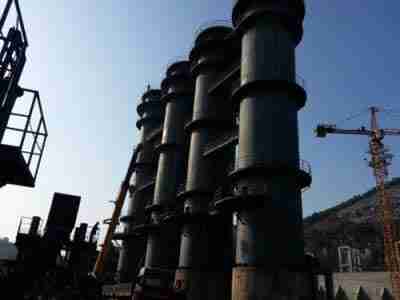
A lime kiln, also known as a white ash kiln, is used for calcination of white ash. Currently, most people use new type environmental lime kiln for calcination, which has brought great convenience to industries such as construction, railways, and highways.
There are generally two common calcination processes for white ash kilns: co-current calcination process and countercurrent calcination process. Because of the different processes, the materials produced by them are also different.
Co-current calcination process
The so-called co-current calcination means that the direction of the limestone material flow in the white ash kiln is the same as the direction of the hot gas flow. Because the material flow direction is the same as the gas flow direction, the material is uniformly heated for a long time during calcination, and the calcination process is extended. Therefore, the product produced under co-current calcination conditions has a high activity, low underburning and overburning, and the quality of the product is easy to control.
Countercurrent calcination process
The so-called countercurrent calcination means that the direction of the limestone material flow in the white ash kiln is opposite to the direction of the hot gas flow. The temperature curve of the combustion air and exhaust gas with the material has only one intersection. The gas temperature needs to be 200-300℃ higher than the combustion temperature required by the material. In the countercurrent calcination process, the material is in the calcination reaction for a short time, and the heat cannot be fully utilized. The heat consumption in the rotary kiln is greatly increased, and the activity of the product produced is limited, and the phenomenon of underburning and overburning in the product is higher.

Precautions for the calcination process of white ash kilns
Feeding and discharging
In fact, feeding and discharging operations are very common, but it is difficult to properly feed and discharge according to the actual calcination situation of the lime kiln, so it is necessary to carry out appropriate feeding operations. In addition, it is also important to keep enough space between the blocks when adding materials. This is more conducive to ventilation and environmental protection in white ash kiln calcination.
Operation precautions for the fireman
Under normal calcination conditions of the environmental protection white ash kiln, it is possible to accurately judge when to use strong wind and when to use small wind to ensure the stable calcination of the fuel in the kiln. In addition, during calcination, we also need to observe whether the composition of limestone, temperature inside the white ash kiln, coal blending, moisture, etc. have changed.
Stopping the kiln
Stopping the kiln is divided into short-cycle stopping and long-cycle stopping. The former refers to external environmental factors such as power failure and water interruption, while the latter refers to problems with the environmental protection white ash kiln itself, such as the replacement of refractory bricks, major or minor repairs, etc. Short-term kiln stopping does not require complete combustion again, while long-term kiln stopping requires turning off the fan and relying on natural wind to operate, while controlling the temperature inside the kiln below 300 degrees.
In many cases, the calcination of lime conflicts greatly with theory. Technically, the calcination of white ash mainly starts from the selection of materials, processing selected stone, managing classified stone, and putting the stone into the kiln. Various kilns are used for calcination.
Pay attention to calcination temperature and time of lime kiln
When using an environmentally friendly lime kiln, attention should be paid to the calcination temperature and time. The relationship between these two aspects is complementary, and only by grasping them well can high-quality lime be produced. Users should not increase the calcination temperature in order to reduce the calcination time, nor should they lower the calcination temperature to extend the calcination time. The temperature is determined by the lining of the kiln and the lump condition of the limestone. The newly built environmentally friendly lime kiln bricks still contain a lot of moisture between the blocks. If they are not dried first before production, a large amount of water vapor will be generated during the production process. The moisture between the bricks will produce water vapor as the temperature rises sharply, and the refractory bricks will crack, seriously affecting the service life of the equipment. Moving the calcination zone upwards is not conducive to protecting the kiln top and effectively utilizing thermal energy. The limestone cannot be fully preheated before entering the calcination zone, wasting energy. The equipment is equipped with a dust removal valve. To reduce heat transfer efficiency, the installation position should be reasonable, which can ensure the effective operation of the lime kiln.