Compared with coke-fired vertical lime kilns, gas-fired lime vertical kilns have the characteristics of high gas flow rate in the kiln, high lime activity, uniform indoor temperature, easy temperature control, low requirements for gas selection, and high thermal consumption.
Technical Characteristics of Lime Vertical Kiln
The furnace design of lime vertical kiln is cylindrical, rectangular+arch-shaped, and other designs with multi-layer sealed vibration ash removal structure. The design includes an air and gas heat exchanger to ensure that the calcination rate and over-burning rate of lime are below 7%, at the same time it can save gas.
For a long time, due to production technology, kiln equipment, and renovation costs, metallurgical lime in small and medium-sized metallurgical enterprises in China has mainly been produced by ordinary vertical kilns fueled by coke and coal. This has resulted in low lime activity and high lime consumption per ton of steel. Currently, the trend is to transform coke-fired vertical kilns into gas-fired vertical kilns for lime production, which has been widely adopted by small and medium-sized enterprises in the metallurgical industry, with further development potential.
Comparison between Gas-fired Lime Vertical Kilns and Coke (Coal)-fired Vertical Kilns
Requirements for air permeability
Gas-fired lime vertical kilns have stricter requirements for air permeability in the kiln. Compared with coke-fired vertical kilns, gas-fired kilns have a gas flow rate 1.5-2 times larger, which has a greater impact on the kiln condition. Therefore, the particle size of lime is required to be around 2mm. Generally, lime stones of 40-80mm are used, and screening and washing can be carried out before entering the kiln if conditions permit.

Indoor temperature
After gas firing, the indoor temperature of the kiln is uniform, and the firing is softer. The process of gradual combustion and heat release of solid fuels is slower than that of gaseous fuels. The residence time of lime stones at high temperatures is longer, and the CaO crystals are coarse and have fewer lattice defects, so the lime activity is slightly lower. Under proper gas flow and air supply ratio, and controlling the particle size of the materials, the flame in gas-fired vertical kilns can penetrate the material layer, ensuring that the calcining zone is uniformly heated without local hot spots. As gas combustion releases heat simultaneously, the lime stones can be quickly calcined and cooled, resulting in high lime activity.
Temperature control of the three zones
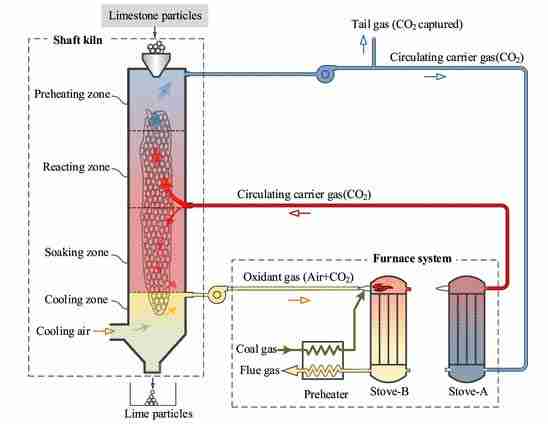
The positions of the three zones in gas-fired kilns are fixed, while solid fuels are not. The temperature of the three zones and the gas temperature, gas flow, and air flow at the kiln entrance can be measured by instruments. The operator can adjust the gas and air flow according to the measurement data, and adjust the wind-to-gas ratio and out-of-kiln time in a timely manner based on factors such as product quality, ore quality, gas pressure, flow rate, heating value, and idle time, stabilizing the kiln condition and lime quality. In coke-fired lime kilns, the combustion situation cannot be adjusted after the material enters the kiln, especially during accidents or idle periods, the calcining zone will slowly move up, increasing over-burning, and the adjustment cycle is longer than that of gas-fired kilns.
Raw Material Requirements
The gas-fired kiln has low requirements for gas selection and a wide range of options. The mixed coke vertical kiln requires high coke strength and low ash content to improve crush resistance, ensure air permeability, and avoid pollution of lime by ash impurities. The gas-fired vertical kiln has a wide range of gas selection, including blast furnace gas, converter gas, producer gas, and their mixed gas with coke oven gas. Especially for many small and medium-sized local enterprises, low calorific value gases such as blast furnace gas and converter gas are abundant and are generally discharged at high altitude, wasting energy and polluting the environment.
1.5 Three-zone temperature changes
Due to the rapid combustion and heat release of gas and the high gas pressure and flow rate in the gas-fired vertical kiln, the calcination zone moves up and the preheating zone shortens, resulting in high smoke temperature and high heat consumption in the preheating zone.
Advantages of Gas-fired Lime Vertical Kiln
- Good quality of metallurgical lime. The activity of gas-fired lime is generally stable at 300-350 mL, and the over-burning rate is less than 7%, which reduces the lime consumption in converter steelmaking to below 70 kg/t.
- Saving and comprehensive utilization of energy. The gas-fired vertical kiln mostly uses low-calorific-value gases such as blast furnace gas and converter gas, which are by-products of steel plants, to save expensive coke and avoid environmental pollution.
- Less investment cost. Small and medium-sized steel plants only need to invest about 1-2 million yuan to retrofit the original 100-150 m3 coke and lime vertical kiln, and can achieve production in three months.
- Simple equipment, convenient operation, and easy regulation.
- Significant economic benefits. Compared with a 150m3 coke oven and a gas-fired kiln producing 35,000 t per year, the benefits of saving coke and reducing the lime consumption (40 kg/t steel) alone can reach about 5 million yuan per year.

Shortcomings of Gas-fired Lime Vertical Kiln
(1) The waste gas temperature at the top of the kiln is high, resulting in high heat consumption and certain difficulties in dust removal.
(2) The gas flow rate and pressure inside the kiln are high, requiring high permeability of the material, and high precision of lime stone particle size.
(3) The kiln requires high sealing performance.
(4) Due to the limitation of flame penetration, the inner diameter of the kiln cannot be too large. Currently, the more mature furnace types in China are 100, 140, 150, 180, 190, and 210.
The gas-fired lime vertical kiln is suitable for China’s national conditions and has many advantages. It has been adopted by many small and medium-sized steel enterprises in China, especially transforming the coke and lime vertical kiln into a gas-fired vertical kiln is an economical and fast way. Continuous improvement of the gas-fired lime kiln is of great significance for its promotion and popularization.