Fuel Types for Lime Burning
Lime production is a high energy consumption and high emission industry. It is well known that various lime kilns have high energy consumption. Most of them have a thermal efficiency of less than 70%, with waste gas heat accounting for more than 20% of the total energy consumption of lime kilns. The waste gas heat utilization rate is only 4% to 5%, indicating significant energy-saving potential.
In traditional lime kiln equipment, the exhaust gas temperature at the kiln tail is generally between 180-250°C. These exhaust gases are almost not subjected to heat exchange treatment and are directly discharged after dust removal, resulting in high unit energy consumption of the products and leading to energy waste. To address issues such as low energy utilization efficiency, poor economic benefits, and outdated energy utilization system technology and management in traditional lime equipment, it is necessary to improve the structure of lime kilns. Currently, the use of more environmentally friendly new lime kilns in lime production is essential. Besides environmental lime kiln, our twin shafts lime kilns, annular shaft lime kiln, vertical lime kilns, rotary lime kilns and so on are also popular.

In the new technology of forging lime with environmental lime kilns, the new structure of environmental lime kilns can strictly control the properties and proportions of limestone and fuel, as well as the firing conditions within the kiln, to obtain high-concentration lime. This not only saves the investment and fuel consumption of dryers but also results in high CO2 content in the exhaust gas, which is safe to use.
To Know More Details About Environmental Lime Kilns!Environmental Lime Kiln Process Flow
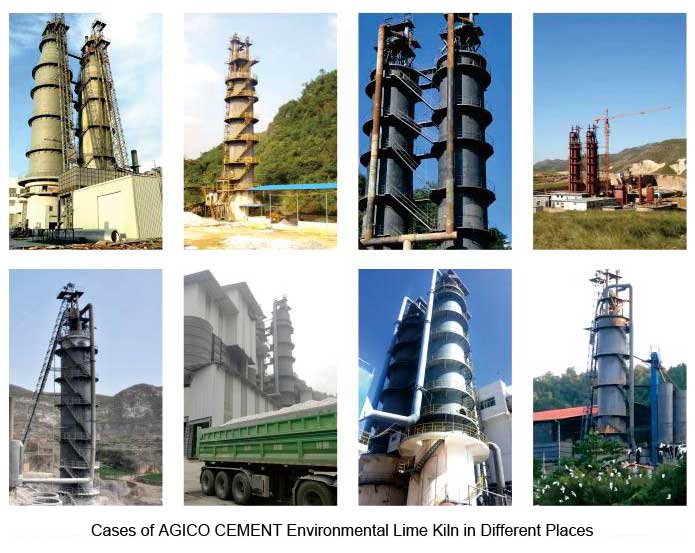
As a well-known lime kiln manufacturer in China, AGICO Cement has developed a series of environmental lime kiln technologies and equipment based on the absorption and reference of similar rotary kilns and shaft kilns at home and abroad, with the design concepts of economic and environmental protection and high production efficiency. These technologies and equipment have achieved the goals of energy-saving, fully automated production, environmentally compliant emissions, high-quality finished lime, and short construction periods. The new type of environmental lime kiln, in conjunction with a vertical preheater and vertical cooler, has advantages such as high raw material utilization, complete calcination, uniform quality, good product quality, large capacity, high operation rate, energy-saving, environmental protection, simple operation, and high automation control. It meets national industrial policies for environmental protection, energy saving, and consumption reduction, making it particularly suitable for the metallurgical, chemical, and building materials industries for calcining limestone.


How Lime Kilns Achieves Environmental Protection
Before dust removal, mixing CaO dust with the smoke turns viscous tar into easily filterable particulate dust and lowers the flue gas temperature, eliminating the need to frequently open the draft valve for cooling, thus saving wind power. For dust with high SO2 content, the smoke mixes with dust before dust removal, and the CaO in the dust deliquesces with the moisture in the smoke and reacts with SO2 to form CaSO4 dust. In AGICO Cement’s environmental kiln production, dust generated during various stages such as raw material hopper, electronic scale weighing, ash discharge, product warehouse screening, and truck loading is designed with draft hoods, which mix under negative pressure and enter the dust collector for standard-compliant discharge. The designed emission is <50mg/m³, and actual measurements are between 30-40mg/m³. After dust removal, the emissions are minimal, achieving environmental protection.
Features of Environmental Lime Kilns
- The main drive system of the new environmental lime kiln adopts a new AC variable frequency speed control technology, which is more energy-efficient and environmentally friendly compared to traditional electromagnetic and DC speed control. It has a large speed control range, high efficiency, high speed control precision, and stable operation.
- The new environmental lime kiln uses an advanced, low-pressure-loss vertical preheater, which can save 40% of fuel and increase output by 30%, recovering the heat in the waste gas, facilitating dust removal, and achieving emission standards of 30mg/m³.
- The kiln head and kiln tail sections have been structurally optimized to address common issues of material return and dust leakage, making material transportation smoother and more natural. The kiln’s upper and lower parts utilize heat exchange to minimize heat loss, effectively utilizing energy.
- The environmental energy-saving mixed-fuel lime rotary kiln achieves rational distribution of the preheating, calcining, and cooling zones within the kiln, fully utilizing fuel heat. The material is preheated to over 1000°C in the preheater by high-temperature flue gas from the rotary kiln, partially decomposing the limestone. The material is then hydraulically pushed into the kiln tail for high-temperature calcination and subsequently discharged into the cooler, where it is cooled to ambient temperature +60°C by air blown in by fans. The cooling air acts as secondary air in the rotary kiln for combustion. The entire operation is closed and automated, with flue gas discharged through pipes and dust-removed for pollution-free emission, ensuring high quality, high yield, and energy savings.
- High-temperature flue gas from the rotary kiln exchanges heat with limestone in the preheater, reducing the temperature to below 250°C before entering the cyclone dust collector for primary dust removal. Large dust particles are captured, then the gas enters a bag filter, and the filtered gas is discharged into the atmosphere through a high-temperature fan, with a dust concentration of less than 30mg/m³, meeting modern environmental standards. A cold air control system at the dust collector’s inlet protects the dust collector.
Reasons for Promoting Environmental Lime Kilns
Reducing Pollution
Traditional lime kilns produce significant CO2, CO, sulfur oxides, and dust during production. Environmental lime kilns use advanced combustion and waste gas treatment technologies to significantly reduce these harmful emissions, improving air quality and reducing environmental damage.
Improving Energy Efficiency
Environmental lime kilns typically use more efficient combustion technologies and heat recovery systems, better utilizing energy, reducing fuel consumption, and increasing production efficiency. This not only lowers production costs but also reduces dependence on fossil fuels, helping to conserve resources.
Complying with Environmental Regulations
With increasing environmental awareness, many countries and regions have enacted strict environmental regulations and standards. Using environmental lime kilns makes it easier to meet these regulations, avoiding fines and legal liabilities due to excessive emissions.
Improving Working Environment
The design of environmental lime kilns focuses on reducing dust and harmful gas leakage, providing a cleaner and safer working environment and reducing health impacts on workers.
Promoting Sustainable Development
Promoting environmental lime kilns is an important measure to drive sustainable industrial development. It helps protect the environment, conserve resources, enhance corporate social responsibility, increase market competitiveness, and promote coordinated economic and environmental development.
Lime Calcined by AGICO Cement Lime Kiln Benefits
- High reactivity of lime.
- Flexible process configuration.
- Efficient use of high-temperature flue gas from the rotary kiln for preheating.
- Enhanced product activity through rapid cooling with a vertical cooler.
- Easier transportation and storage.
AGICO Cement’s lime kilns produce high-reactivity lime. The process configuration is flexible, allowing for the integration of a vertical preheater at the kiln tail to fully utilize the high-temperature flue gas generated in the rotary kiln to preheat the limestone from ambient temperature to the initial decomposition state. Additionally, a vertical cooler can be configured at the kiln head to rapidly cool the high-temperature lime, enhancing its activity, and making it easier for transportation and storage.
Environmental lime kilns offer significant benefits in terms of pollution reduction, energy efficiency, regulatory compliance, working environment improvement, and sustainable development, making them a vital part of modern industrial processes.