Methods for Improving the Sealing of Energy-Saving Lime Kilns
AGICO Cement is a company that specializes in designing, renovating, igniting, and providing production and automation services for energy-saving and environmentally friendly lime kilns. Its related products mainly include top charging equipment, disc ash unloading machine, computer-simulated wind cap, sealed chamber ash unloading valve, star ash unloading machine, bluestone coal weighing system, supporting hoist, vibrating feeder, and more. Below is an introduction to the methods for improving the sealing of energy-saving and environmentally friendly lime kilns.
As we all know, the sealing performance of engineering lime kilns directly affects fuel consumption. The heat storage capacity of lightweight foam insulation bricks and aluminum silicate refractory fiber blankets used in the construction of energy-saving and environmentally friendly lime kilns is only about 10% of that of refractory bricks. When using the above-mentioned insulation materials to build kiln walls and kiln roofs, the thermal insulation performance of the kiln is good. During the high-temperature stage, the surface temperature of the iron plate combustion chamber outside the kiln, as measured by a WREA-890M surface thermometer, is only 50-80°C, which can reduce fuel consumption by 10-15%. The sealing of energy-saving and environmentally friendly lime kilns is particularly important, and its improvement method is the focus of our research.
Energy-saving and environmentally friendly lime kilns use lightweight foam insulation bricks and aluminum silicate refractory fiber blankets to build kiln furnaces. Although the one-time engineering cost is higher, the significant energy-saving effect can recover the construction cost within a few months after production.
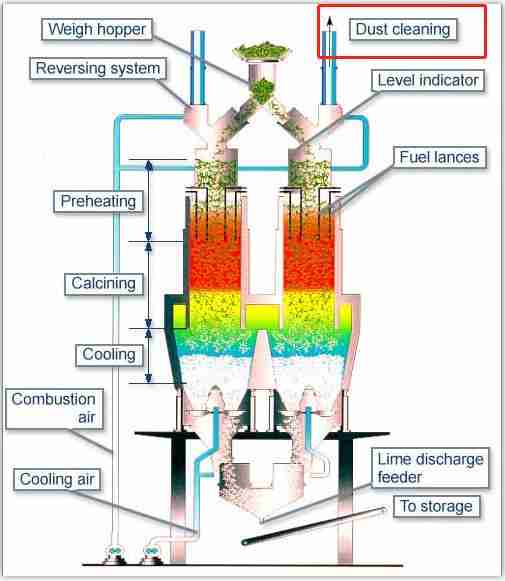
The kiln car and kiln body of the energy-saving and environmentally friendly lime kiln are sealed with a winding and sand-sealed structure. The joints, periphery, and contact surface of the kiln car and kiln body inside the kiln are pasted with 30mm thick aluminum silicate refractory fiber blankets to effectively prevent the temperature rise of the kiln gas and the infiltration of cold air, increase the sealing performance of the kiln, reduce the temperature difference between the top and bottom of the kiln, reduce heat loss, shorten the high-temperature insulation time, and promote the reduction of fuel consumption. The main feature of the lime kiln is dust removal, which is very favorable for advocating environmental protection and emission reduction. The lime kiln dust removal system cleverly mixes flue gas and dust to achieve standard emissions. The system is precise and has more advanced and environmentally friendly dust removal effects than other lime kilns.

Dust removal in lime kilns
The lime kiln mixes flue gas, smoke, and station dust into the bag filter system. Before dust removal, mixing CaO dust into the flue gas can turn sticky tar into easily filterable particle dust and reduce the flue gas temperature, solving the problem of high temperature damage to the filter bags in single flue gas dust removal. Since the flue gas contains a certain amount of tar, it is often prone to clogging the filter bag pores, but opening the induced draft valve to reduce the temperature and wasting wind power can be avoided.
For smoke and dust with high SO2 content, the lime kiln dust removal system mixes the flue gas and dust, and the CaO in the dust reacts with the moisture in the flue gas to generate CaSO4 microdust. In the production operation of this kiln, during processes such as raw material hopper-electronic scale weighing-ash discharge-finished product bin screening-vehicle loading, dust is generated, and each area has a wind hood.
The lime kiln works under negative pressure, which can effectively prevent dust and harmful gases from escaping and ensure the environmental protection of the production process. At the same time, it is equipped with a monitoring system that can monitor the temperature, pressure, and dust removal effect of the kiln in real-time, ensuring the safe and stable operation of the kiln.
In conclusion, the energy-saving and environmentally friendly lime kiln has excellent thermal insulation performance and sealing performance, which helps to reduce heat loss and prevent air pollution. It is an important tool for the sustainable development of the lime industry, as it significantly reduces the consumption of fuel and the emission of harmful gases. Moreover, the lime produced by this kiln has higher quality and is more widely used in various industries, such as construction, steelmaking, and chemical manufacturing. The lime kiln represents a significant advancement in industrial technology, and its use should be encouraged to promote a cleaner and more sustainable industrial sector.